Garmin HRV Status Unbalanced: What to Do

Cameron Usher · Founder, px
· 7 min read
Twelve years in competitive sport, trained alongside the Australian Olympic squad. px is the coach he needed after ten coaches, every wearable and every protocol.

Garmin HRV status unbalanced, in short
Garmin HRV status unbalanced means your seven-day average of overnight heart rate variability has moved outside your own baseline range, either above it or below it. It describes your past week, not this morning. Check last night's reading, your resting heart rate and your sleep. If they are normal, train as planned. If they are off too, ease today's session.
What does unbalanced mean on Garmin HRV status?
It means your recent HRV has left your normal range. It does not mean something is wrong.
Heart rate variability (HRV) is the small variation in time between one heartbeat and the next. A Garmin watch reads it from your wrist while you sleep. Each morning it compares your seven-day average with a baseline range built from your own nights. Garmin's manual sets out five statuses:
| Status | What it means |
|---|---|
| Balanced | Your seven-day average sits inside your baseline range. |
| Unbalanced | Your seven-day average sits above or below your baseline range. |
| Low | Your seven-day average sits well below your baseline range. |
| Poor | Your values average well below the normal range for your age, rather than your own range. |
| No status | There are not yet enough nights to make a seven-day average. |
Two details matter. The status needs three weeks of consistent sleep data before it appears, so a new watch, or a month of wearing it on and off, tells you little. And unbalanced has two sides. Garmin's own wording is "above or below your baseline range", so a high average turns the same orange as a low one.
Garmin's manual says an unbalanced status may be a sign of fatigue, a greater need for recovery or more stress. May is the important word. The status is a prompt to look, not a verdict.
Why does Garmin use a seven-day average instead of last night?
Because one morning's HRV is noisy, and a week of mornings is not.
In 2013, Daniel Plews and colleagues followed 10 runners through nine weeks of training (Plews et al., 2013). A single morning's HRV had almost no relationship with how their aerobic fitness changed, a correlation close to zero. The weekly average tracked the change closely, with a correlation of 0.72. Their conclusion was that averaging HRV over a week is the more useful way to read it.
The cost of an average is lag. A seven-day average moves days after the night that moved it, and it can stay unbalanced for days after that night has passed. So the status tells you about the shape of your week. Last night's reading tells you about this morning. You need both before you decide anything.
Is unbalanced above your baseline different from below it?
Yes. Read the direction before you read the color.
Below your range is the reading most people expect. It tends to follow a run of hard sessions, short or broken sleep, alcohol, heat, a long flight, a stressful week at work, or the start of an illness. Each of these can lower overnight HRV on its own, and together they add up.
Above your range confuses people, because higher HRV sounds like better HRV. It is not a grade. An average above your normal can follow an easy week, a taper before an event or a big change in your training. Garmin flags it because it is unusual for you, not because it is good or bad.
So read it with the rest of the morning:
- A high average with a normal resting heart rate, good sleep and fresh legs needs no change.
- A high average with a raised resting heart rate and poor sleep deserves the same care as a low one.
The HRV status chart in Garmin Connect draws your seven-day average against the shaded band of your baseline. One look tells you which side of the band you are on, and for how many days. Garmin shows two more morning numbers beside it, and each has its own page: Training Readiness and Body Battery.
What should you check when your HRV status is unbalanced?
Four things, in this order, each against your own normal.
- Last night's HRV. Is it still out of range, or back inside it? An unbalanced status after a normal night is usually an average catching up.
- Your resting heart rate. Is it 3 or more beats per minute above your usual morning value?
- Your sleep. Was it shorter than your normal, or broken?
- What changed this week. More training, more alcohol, later meals, a long flight, a hot week, a deadline, a sore throat.
Alcohol shows how far one evening can move the number. In a study of 4,098 Finnish employees across more than 12,000 nights, an HRV-based measure of recovery in the opening three hours of sleep fell by about 9, 24 and 39 percentage points after low, moderate and high alcohol intake (Pietilä et al., 2018). Work stress can show up in a similar way, and how work stress shows up in your HRV covers what to look for.
HRV can tell you that something changed. It cannot tell you what. If you have a fever or chest pain, or you feel unwell, do not train hard, and talk to a doctor. No training number outranks how you feel when you are sick.
Should you train when your HRV status is unbalanced?
Usually yes, at a lighter load. What decides it is whether your other signals agree.
| What you find this morning | What to do today | Why |
|---|---|---|
| Unbalanced, but last night, resting heart rate and sleep are all normal | Train as planned and keep the load steady | The average is catching up with a week that is already settling |
| Unbalanced below, plus one other signal off | Train, trimmed: the same session, shorter or easier | Two signals agree |
| Unbalanced below for most of the week, plus short sleep or a raised resting heart rate | Switch the hard session to easy aerobic work and move it 2 to 3 days later | The pattern is real and not easing |
| Low, with a raised resting heart rate and short sleep | Recover on purpose: rest, or easy activity | Several signals agree |
| Unbalanced above, with a normal resting heart rate, good sleep and fresh legs | Train as planned | Above your range is not a warning on its own |
| Any status, plus a fever, chest pain or feeling unwell | Rest, and talk to a doctor | Symptoms outrank every number |
The four outcomes in that table, as planned, trimmed, switched or recover, are the same ones Should I Train Today? works through signal by signal. If short sleep is the main thing off, training after a bad night's sleep has the detail. If the status has sat low for more than a week, Do I Need a Rest Day? covers how to tell ordinary tiredness from something that needs more rest.
Moving a hard session is not losing it. A 2021 meta-analysis pooled 8 studies and 199 people who either followed a fixed training plan or moved their hard sessions according to their morning HRV (Manresa-Rocamora et al., 2021). The HRV-guided groups matched the fixed-plan groups on aerobic fitness and endurance performance, and their HRV improved more. The hard sessions still happened. They happened on the days the signals allowed.
HRV status · a seven-day average
Unbalanced has two sides.
The status tells you about the shape of your week. Last night's reading tells you about this morning.
What does px do with your Garmin data?
px reads what your Garmin shares with it: your sleep, your resting heart rate and the training you logged. It reads them alongside your calendar and how you say you feel, against your own normal, never against anyone else's, and sizes the day from all of it. It does not read Garmin's HRV Status itself, so the four checks above stay yours. Everything px reads from a Garmin is listed on px and Garmin.
When your resting heart rate runs above your normal or your sleep runs short, px can change today's session, and the reason goes on the session. A morning like the third row of the table reads like this (illustrative):
"Your resting heart rate is up 5 beats and you have slept under your normal for three nights, so today's intervals become 40 easy minutes. Thursday takes the intervals."
After a short night the call can be blunter. One of px's own lines reads: "Sleep debt is the bottleneck… Today is short and easy."
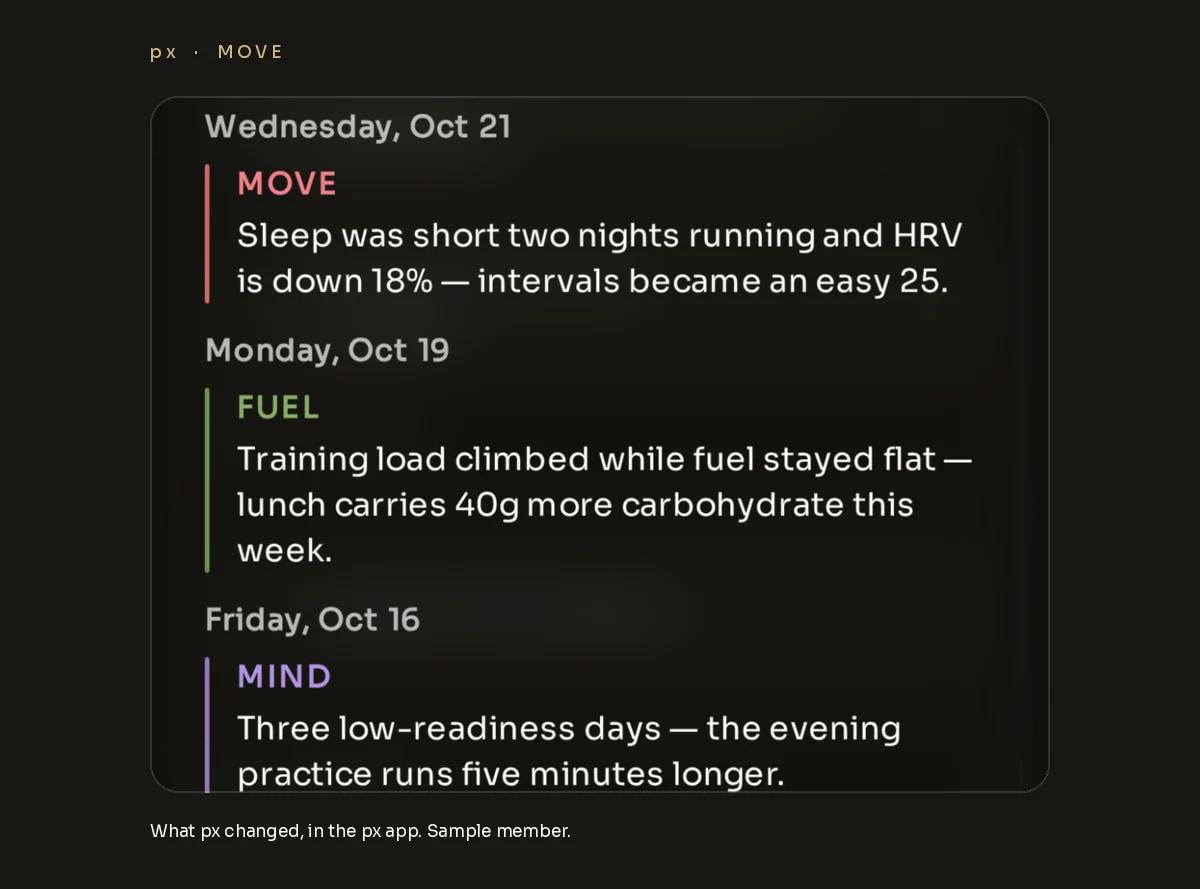
Every change px makes to a session is written down with the signal behind it and the reason. You can look back over the last two weeks of them in your Plan, under What px changed, so a lighter Tuesday never reads as a missed one. In the sample record below, from a member whose watch also shares HRV, two short nights and an 18% drop in HRV turned a set of intervals into an easy 25. Nothing changes on your watch. px reads what it already records.
For each status Garmin shows and what to do with it, see Garmin HRV Status: train or rest. For the wider question of turning everything your wearable records into one plan for the day, start with biometric training.
The status describes your week. The call for today still needs this morning.
Frequently asked questions
Why is my Garmin HRV status unbalanced when I feel fine?
Because the status reports a seven-day average, not how you feel today. The average can drift outside your baseline after a hard block, a few short nights or a stressful week, and it can stay out after you have recovered. Check last night's HRV and your resting heart rate. If both are normal, train as planned.
How long does Garmin HRV status stay unbalanced?
It follows a seven-day average, so it trails whatever moved it. A few nights back inside your normal range pull it back toward balanced. A week of short sleep, hard training or illness keeps it out longer. If it stays unbalanced or low for more than a week with no clear reason, ease your training.
Is a high HRV status on Garmin a good sign?
Not on its own. Garmin marks an average above your baseline range as unbalanced, like one below it, because both are unusual for you. After an easy week with a normal resting heart rate and good sleep, it needs no change. With a raised resting heart rate and poor sleep, give it the same care as a low one.
Sources (5)
- Garmin. Heart Rate Variability Status. Forerunner 265 Owner's Manual. https://www8.garmin.com/manuals/webhelp/GUID-F41EAFB3-6CC9-42DE-9C6C-9E358DBB0671/EN-US/GUID-9282196F-D969-404D-B678-F48A13D8D0CB.html
- Garmin. Understanding the HRV Status on Your Garmin Smartwatch. Garmin blog, 2024, updated 2026. https://www.garmin.com/en-US/blog/fitness/understanding-the-hrv-status-on-your-garmin-smartwatch/
- Plews DJ, Laursen PB, Kilding AE, Buchheit M. (2013). Evaluating training adaptation with heart-rate measures: a methodological comparison. International Journal of Sports Physiology and Performance, 8(6), 688 to 691. https://doi.org/10.1123/ijspp.8.6.688
- Pietilä J, Helander E, Korhonen I, Myllymäki T, Kujala UM, Lindholm H. (2018). Acute effect of alcohol intake on cardiovascular autonomic regulation during the first hours of sleep in a large real-world sample of Finnish employees: observational study. JMIR Mental Health, 5(1), e23. https://doi.org/10.2196/mental.9519
- Manresa-Rocamora A, Sarabia JM, Javaloyes A, Flatt AA, Moya-Ramón M. (2021). Heart rate variability-guided training for enhancing cardiac-vagal modulation, aerobic fitness, and endurance performance: a methodological systematic review with meta-analysis. International Journal of Environmental Research and Public Health, 18(19), 10299. https://doi.org/10.3390/ijerph181910299
Worth passing on? Share it.
