How Much Protein Per Day for Training?

Cameron Usher · Founder, px
· 7 min read
Twelve years in competitive sport, trained alongside the Australian Olympic squad. px is the coach he needed after ten coaches, every wearable and every protocol.

How much protein per day for training, in short
For training, most people need 1.4 to 2.0 g of protein per kg of bodyweight a day, the range the International Society of Sports Nutrition gives. For a 70 kg person that is about 100 to 140 g, eaten as three or four meals of 20 to 40 g. Past about 1.6 g per kg, extra protein adds little muscle.
How much protein per day do you need for training?
Between 1.2 and 2.0 g per kg of bodyweight a day, and for most people who train regularly, 1.4 to 2.0 g.
Protein needs are given in grams per kilogram of bodyweight per day (g per kg) because a bigger body needs more. The main reference points line up like this:
| Source | Who it is for | Daily protein |
|---|---|---|
| Recommended Dietary Allowance, US and Canada (Institute of Medicine, 2005) | Adults in general | 0.8 g per kg |
| Joint position of the Academy of Nutrition and Dietetics, Dietitians of Canada and the American College of Sports Medicine (Thomas, Erdman and Burke, 2016) | Athletes | 1.2 to 2.0 g per kg |
| International Society of Sports Nutrition position stand (Jäger et al., 2017) | Most people who exercise | 1.4 to 2.0 g per kg |
| Meta-analysis of 49 trials, 1,863 people (Morton et al., 2018) | People lifting to build muscle | Gains leveled off at 1.62 g per kg |
The 0.8 g figure is set to cover the needs of nearly all healthy adults. It is a floor for everyday life, not a target for a training week. Once you train most days, the two sports nutrition position stands put you at roughly double it.
How do you work out your own protein number?
Four steps, about two minutes.
- Find your bodyweight in kilograms. If you know it in pounds, divide by 2.2.
- Multiply by 1.6. That is a sound starting point for most people who train. Use 1.4 if you train two or three times a week. Go toward 2.0 if you train hard most days or building muscle is the goal.
- Divide it across your meals. Three or four meals of about 0.3 to 0.4 g per kg each gets you there.
- Check one ordinary day. Add up the protein in what you already eat and see how far it sits from your number.
| Bodyweight | 1.4 g per kg | 1.6 g per kg | 2.0 g per kg |
|---|---|---|---|
| 60 kg (132 lb) | 84 g | 96 g | 120 g |
| 70 kg (154 lb) | 98 g | 112 g | 140 g |
| 80 kg (176 lb) | 112 g | 128 g | 160 g |
| 90 kg (198 lb) | 126 g | 144 g | 180 g |
The daily protein calculator does the same sums for your own weight and goal, and gives the range as grams.
Protein · grams a day, by bodyweight
Your protein, by bodyweight
60 kg
132 lb
70 kg
154 lb
80 kg
176 lb
90 kg
198 lb
70 kg at 1.6 g per kg: four meals of 28 g
Breakfast
28 g
Lunch
28 g
Afternoon
28 g
Dinner
28 g
The day's total does most of the work.
Does strength or endurance training change the number?
Less than most people expect. Neither position stand gives strength and endurance training separate headline ranges.
Both put people who train inside the same band, and where you sit inside it depends on three things: how often you train, how hard, and whether building muscle is part of the goal. Someone running three easy sessions a week sits near the bottom of the range. Someone lifting four times a week to add muscle sits at 1.6 or above. A heavy block of either kind moves you up.
What changes much more between strength and endurance is carbohydrate. That is the part of a training diet that should rise and fall with the week, and a training nutrition plan that moves with your training load covers it in full.
How should you split protein across the day?
Evenly, across three or four meals, rather than in one large dinner.
The International Society of Sports Nutrition suggests 0.25 g per kg per meal, or 20 to 40 g, every 3 to 4 hours (Jäger et al., 2017). A 2018 review by Brad Schoenfeld and Alan Aragon goes a little higher for people building muscle: 0.4 g per kg per meal across at least four meals, which reaches 1.6 g per kg a day (Schoenfeld and Aragon, 2018). The joint position stand lands in between, at 0.3 g per kg after key sessions and every 3 to 5 hours.
For a 70 kg person, 0.4 g per kg is 28 g a meal. Four meals of that size come to 112 g, which is 1.6 g per kg for the day.
The timing around a single session matters far less than the total. Do You Need Protein Before a Morning Workout? goes through that research, and the short answer is that the day's total does most of the work. If the week is the hard part, fast meals for a packed training week gives a structure that keeps protein in every meal.
Do you need protein shakes to reach your number?
No. A shake is a convenience, not a requirement.
Every figure in this post is total protein from all sources. None of the position stands asks for any of it to come from a powder. Ordinary meals reach these numbers: eggs, yogurt, milk, cheese, fish, meat, beans, lentils and tofu all carry protein, and a plate built around one of them covers a meal's share.
A shake earns its place on the day that runs away from you, when a meal gets missed and the evening is short. It is a quick way to catch up. It is not the way to build the habit, and it is not where muscle comes from. Eating protein at every meal is.
Do you need more protein on training days than rest days?
No. Keep protein about the same every day.
The muscle-building effect of a session lasts at least 24 hours, according to the International Society of Sports Nutrition, so the day after training uses protein too. That is why every source above gives protein as a daily figure, not a per session one.
Rest days still need food. The part of a training diet that should move with the day is carbohydrate: more on a long or hard day, less on an easy one. Protein stays steady underneath it.
Is there a point where more protein stops helping?
Yes, for building muscle, on average.
In the largest analysis of the question, Robert Morton and colleagues pooled 49 trials and 1,863 people who did resistance training. Gains in lean mass leveled off at about 1.62 g per kg a day (Morton et al., 2018). The uncertainty around that average ran from 1.03 to 2.20 g per kg, so the authors suggested about 2.2 g per kg for people who want the margin.
Past that point, protein is still food. It fills you up and takes room from the carbohydrate a hard training week needs. More is not more useful.
If you have a medical condition, or a doctor has given you a protein limit, follow their number over any range here.
How does px set your protein target?
px sets your daily protein target from your bodyweight: 1.6 g per kg to start, higher when your goal calls for it, and never above 2.2 g per kg. The reason sits on the target, so you can see where the number came from.
Your Nutrition then builds a recommended day with protein in every main meal, ranked against what you still have left to eat. As the day goes on, a row tells you how far you are from the target, for example "40g of protein to go". On a day your training load runs high, the target the coach works from adds 15 g of protein.
A late afternoon on a training day reads like this (illustrative):
"You have 38 g of protein to go and dinner is your last main meal, so tonight's recipe carries most of it."
That is food planned around your day, not a number to chase. For your own number before you start, try the daily protein calculator.
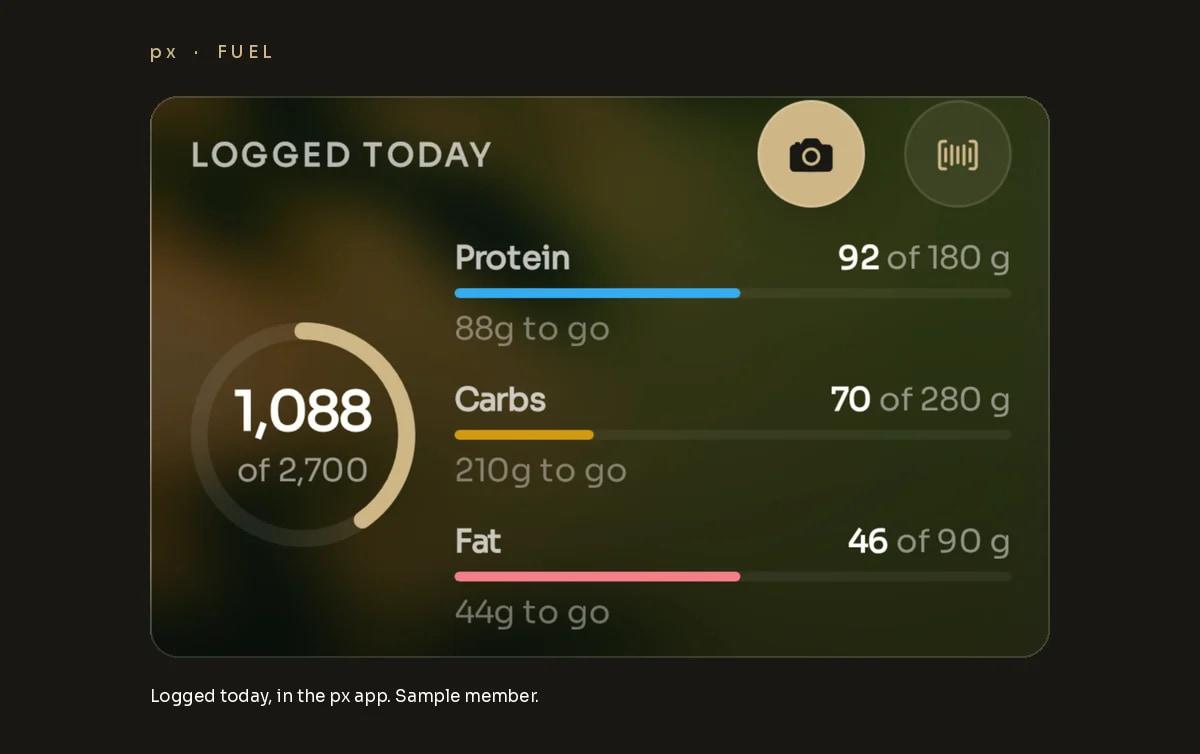
Protein is a daily number, not a gym number.
Frequently asked questions
How much protein do I need per day to build muscle?
About 1.6 g per kg of bodyweight a day for most people. In a meta-analysis of 49 trials, gains in lean mass leveled off around 1.62 g per kg, with a range up to about 2.2 g. Spread it over three or four meals. A 75 kg person would aim for about 120 g.
Is 1 gram of protein per pound of bodyweight too much?
It is more than most people need. One gram per pound is about 2.2 g per kg, the top of the range researchers suggest for people who want a margin when building muscle. On average, gains in lean mass leveled off around 1.6 g per kg, so protein above that rarely adds more muscle.
Should I eat less protein on rest days?
No. Keep protein about the same every day. The muscle-building effect of training lasts at least 24 hours, so the day after a session uses protein too. What can change with your training is carbohydrate: more on long or hard days, less on easy ones. Protein stays steady, spread across your meals.
Sources (5)
- Institute of Medicine. (2005). Dietary Reference Intakes for Energy, Carbohydrate, Fiber, Fat, Fatty Acids, Cholesterol, Protein, and Amino Acids. Washington, DC: The National Academies Press. https://doi.org/10.17226/10490
- Thomas DT, Erdman KA, Burke LM. (2016). Position of the Academy of Nutrition and Dietetics, Dietitians of Canada, and the American College of Sports Medicine: Nutrition and Athletic Performance. Journal of the Academy of Nutrition and Dietetics, 116(3), 501 to 528. https://doi.org/10.1016/j.jand.2015.12.006
- Jäger R, Kerksick CM, Campbell BI, et al. (2017). International Society of Sports Nutrition Position Stand: protein and exercise. Journal of the International Society of Sports Nutrition, 14, 20. https://doi.org/10.1186/s12970-017-0177-8
- Morton RW, Murphy KT, McKellar SR, et al. (2018). A systematic review, meta-analysis and meta-regression of the effect of protein supplementation on resistance training-induced gains in muscle mass and strength in healthy adults. British Journal of Sports Medicine, 52(6), 376 to 384. https://doi.org/10.1136/bjsports-2017-097608
- Schoenfeld BJ, Aragon AA. (2018). How much protein can the body use in a single meal for muscle-building? Implications for daily protein distribution. Journal of the International Society of Sports Nutrition, 15, 10. https://doi.org/10.1186/s12970-018-0215-1
Worth passing on? Share it.
