Is Clean Eating Necessary for Athletes? Why Fuelling Well Is Not the Same Thing

Cameron Usher · Founder, px
· Updated · 10 min read
Twelve years in competitive sport, trained alongside the Australian Olympic squad. px is the coach he needed after ten coaches, every wearable and every protocol.

Is clean eating necessary for athletes? In short
Clean eating is not necessary for athletes. It has no agreed definition, so it is a set of rules and exclusions, not a plan. Those rules make it easier to under-fuel hard days and cut carbohydrate when training needs it. Fuelling well is permission plus a plan: enough energy, protein through the day, carbohydrate matched to training, and variety.
You did intervals at six. There is a strength session at seven tonight. Breakfast was egg whites, lunch was a salad, and the bread in the office kitchen stayed where it was, because you are eating clean this month. By the third set the bar feels heavier than last week. You put it down to effort.
So is clean eating necessary for athletes? No. "Clean eating" has no agreed definition, so it cannot be a plan. It is a set of rules and exclusions, and rules framed as purity make fuelling harder: hard days go short, carbohydrate gets cut when training needs it, and a meal that breaks a rule turns into guilt. Fuelling well is permission plus a plan.
What does "eating clean" actually mean?
Nobody agrees. Asked to define it, 1,020 Americans aged 14 to 24 gave scattered answers: 39.7 per cent said whole or unprocessed foods, 38.7 per cent said simply healthy and 29.7 per cent described avoiding foods (Ambwani et al., 2020, Nutrients). Among 148 undergraduates, 46 per cent defined it by what you add and 49 per cent by what you remove (Ambwani et al., 2019). An Australian study of 762 women noted there is "no consensus or definition", yet 25.5 per cent of them followed advice from clean eating websites at least sometimes (Allen, Dickinson and Prichard, 2018, Nutrients).
None of these samples were athletes, so read them for the shape: the phrase has no fixed meaning, and many people define it by what it takes away. A 2026 analysis of 300 short social media videos under #cleaneating and related tags found food restriction rules in 28.7 per cent of them (Porteous et al., 2026, Journal of Technology in Behavioral Science).
A phrase with no agreed meaning cannot tell you what to eat before intervals. It can only generate rules. Researchers have raised concerns about rigid food rules; this post stays on performance.
How can food rules make you fuel worse?
Rules are built to say no. Training asks for more on the hardest days.
Hard days go short
The International Olympic Committee's 2023 consensus notes that under-fuelling can be unintentional, simply "failing to consciously increase" intake as training rises. The performance costs it lists include a weaker training response, slower recovery, and lower strength, endurance and power (Mountjoy et al., 2023, British Journal of Sports Medicine). It was written for competitive athletes, but the principle travels. A rule list that forbids quick, dense food is a reliable way to eat the same on a double day as on a rest day.
Carbohydrate gets cut when training needs it
Across 21 studies of 511 professional and semi-professional team-sport athletes, most studies found protein and fat intakes met or exceeded recommendations. Carbohydrate was the gap: 15 of the 17 studies that reported it found intakes below recommendations (Jenner et al., 2019, Nutrients). Food records under-report, so hold the size loosely. Plenty of protein and too little carbohydrate is also the shape you would expect from a rule list built on less bread and more chicken.
The joint position stand from the Academy of Nutrition and Dietetics, Dietitians of Canada and the American College of Sports Medicine scales carbohydrate to the work. Its daily ranges run from 3 to 5 g per kilogram on light days to 8 to 12 g on days of four to five hours or more (Thomas, Erdman and Burke, 2016, Journal of the Academy of Nutrition and Dietetics). Those are population ranges, not a prescription. The same stand corrects a near-universal clean eating instinct: before an event, foods low in fat and fibre are the preferred choice. The white bagel the rule forbids is closer to the evidence than the high-fibre bowl it approves. Skipping breakfast before hard work is its own question: see fasted vs fed training.
A broken rule becomes guilt
Under a plan, the pasta at a friend's dinner is fuel. Under a rule, it is a lapse, and the guilt does no work. The Mind post on why you feel guilty for resting covers evidence that guilt-driven motivation tracks behaviour about half as well as reasons you actually hold. There is little reason to think it works better at the table.
Food rules · why they compound
The rule loop
- 1A food rule
- 2A hard day eaten like an easy one
- 3A flat session
- 4Guilt
- 5A stricter rule
Back to 1, a food rule, and round again.
The way out · a plan
Today's training sets today's food
Rules compound on themselves. A plan leaves the loop because it starts from the session, not the list.
Why do flexible food rules outlast rigid ones?
Researchers separate two ways of controlling food. Rigid control is all or nothing: foods are allowed or forbidden, the day kept or broken. Flexible control has no forbidden list; foods are eaten in sensible amounts without the verdict (Westenhoefer, Stunkard and Pudel, 1999). Much of what gets called clean eating is rigid control with a nicer name.
The evidence leans flexible. In 223 adults from the general population, the strongest pattern in the data (canonical correlation 0.65) grouped flexible dieting with an absence of overeating (Smith et al., 1999, Appetite). In 188 women, rigid dieting carried the associations researchers worry about and flexible dieting did not (Stewart, Williamson and White, 2002, Appetite). Both are snapshots: association, not cause.
One honest correction. The guilt post covers field evidence that one broken rule does not reliably tip people into eating more afterwards. So the case against rigid rules is not that one slip wrecks you. It is what they cost on the days they hold: less fuel, less carbohydrate, more guilt, and a plan sized for your best week. The Mind pillar on how to stay consistent with training makes the same case for sessions: plans built for the worst week last.

Is processed food the real problem?
This is the strongest part of the clean eating case. In a controlled trial, 20 adults on a research ward spent two weeks on an ultra-processed diet and two on an unprocessed one, with meals matched for calories offered, energy density, macronutrients, sugar, sodium and fibre. On the ultra-processed diet they ate 508 kcal a day more (Hall et al., 2019, Cell Metabolism). A real effect, in a small, short, artificial setting.
In 2025 the UK's Scientific Advisory Committee on Nutrition found "consistent associations" between eating more ultra-processed food and worse health outcomes. It also said it "remains unclear" how much of that is explained by nutritional factors already known to matter and flagged "concerns and difficulties" with the classification most studies use (SACN, 2025). Its advice did not change: eat less processed food that is high in energy, saturated fat, salt and free sugars and low in fibre.
Sensible, and not the same as treating everything processed as off limits. A sports drink on a long ride, a bagel before intervals and tinned fish are all processed. What matters is what is in the food and the job it does today, a finer line than any purity label can draw.
What does fuelling well look like instead?
Permission plus a plan, in five parts:
- Enough energy for the work. Intake rises on the days training rises, because that is where unintentional shortfalls start.
- Protein across the day. The joint position stand favours "a regular spread of moderate amounts of high-quality protein across the day", because recovery is not one meal.
- Carbohydrate matched to training. More on heavy days, less on light ones, chosen around sessions for how it sits, not how it looks.
- Variety. A forbidden list narrows what you eat by design; a plan cares what a food does, not its category.
- Room for food you simply enjoy. Not as a reward or a lapse. As food, for the flexible control reasons above.
The other pillars feed this daily. A short night pulls appetite towards easy, rewarding food. A rule reads that as weakness; a plan reads it as a signal (why a short night changes what you reach for). An injury cuts your training, and the rule-shaped instinct is to cut food with it; look closer first (what to eat when you are coming back from injury). For the full version, see how to build a training nutrition plan around your training load.
How do you spot bad nutrition advice?
Start from the base rate. A 2023 systematic review of 64 studies grading online nutrition information found almost half rated its quality low (20 of 41) or its accuracy poor (23 of 47). The publisher mattered more than the platform, and both studies that looked at dietitians rated their information higher (Denniss, Lindberg and McNaughton, 2023, Public Health Nutrition).
Popularity is no guide. A University of Glasgow pilot scored nine popular UK influencers' diet blogs for credibility. One passed: the only Registered Nutritionist (Sabbagh et al., 2020, International Journal of Environmental Research and Public Health). It was small, with one coder. In the larger 2026 video analysis, 78 per cent of creators had no relevant qualification, and 68 per cent of the nutrition and exercise information was rated misleading or deceptive. Qualified creators were accurate 45.5 per cent of the time, everyone else 4.7 per cent (Porteous et al., 2026). Yet qualified creators still misled 40.9 per cent of the time. A title raises the odds; it does not replace checking the claim.
Check the title
- UK: "dietitian" is protected, and anyone using it must be registered with the Health and Care Professions Council. "Nutritionist" is not protected; qualified nutritionists can join the Association for Nutrition's UK Voluntary Register of Nutritionists.
- Australia: "anyone can call themselves a nutritionist without having any specific training" (healthdirect). Look for an Accredited Practising Dietitian, the credential Dietitians Australia runs and government bodies recognise.
- New Zealand: search the Dietitians Board public register.
Seven questions to ask of any nutrition claim
| Ask | Walk away if |
|---|---|
| Is there a named study I can open? | The only evidence is a testimonial |
| Were the people studied like me? | They were rodents, patients or non-exercisers, or you cannot tell |
| How big was the effect, against what? | You get a percentage with no baseline |
| One study, or the weight of evidence? | One small study is sold as settled |
| Who benefits if I believe it? | The fix is sold in the same post |
| Does it cut out a whole food group? | Exclusion is the plan and no clinician asked for it |
| Does it talk about purity, toxins or guilt? | Food is described as earned, dirty or forbidden |
What does px do instead of food rules?
The px Fuel coach works to written rules that point the other way: never demonise food, never create fear, never moralise food, and treat food as abundance, not punishment. When you travel somewhere with amazing food, the instruction is to eat it. There is no reward meal to earn and no food to pay back with a session.
The plan protects you from under-fuelling instead of rewarding it. Late on a day you have burned a lot in training and eaten well under target, px trims that day's Move and Mind sessions by 10 minutes, shows you why, and caps the day's Fuel score so a short day cannot score highly. An illustrative card, with simulated figures:
Fuel is well under target after this morning's intervals, so tonight's session is 10 minutes shorter. The morning's work has not been eaten back yet.
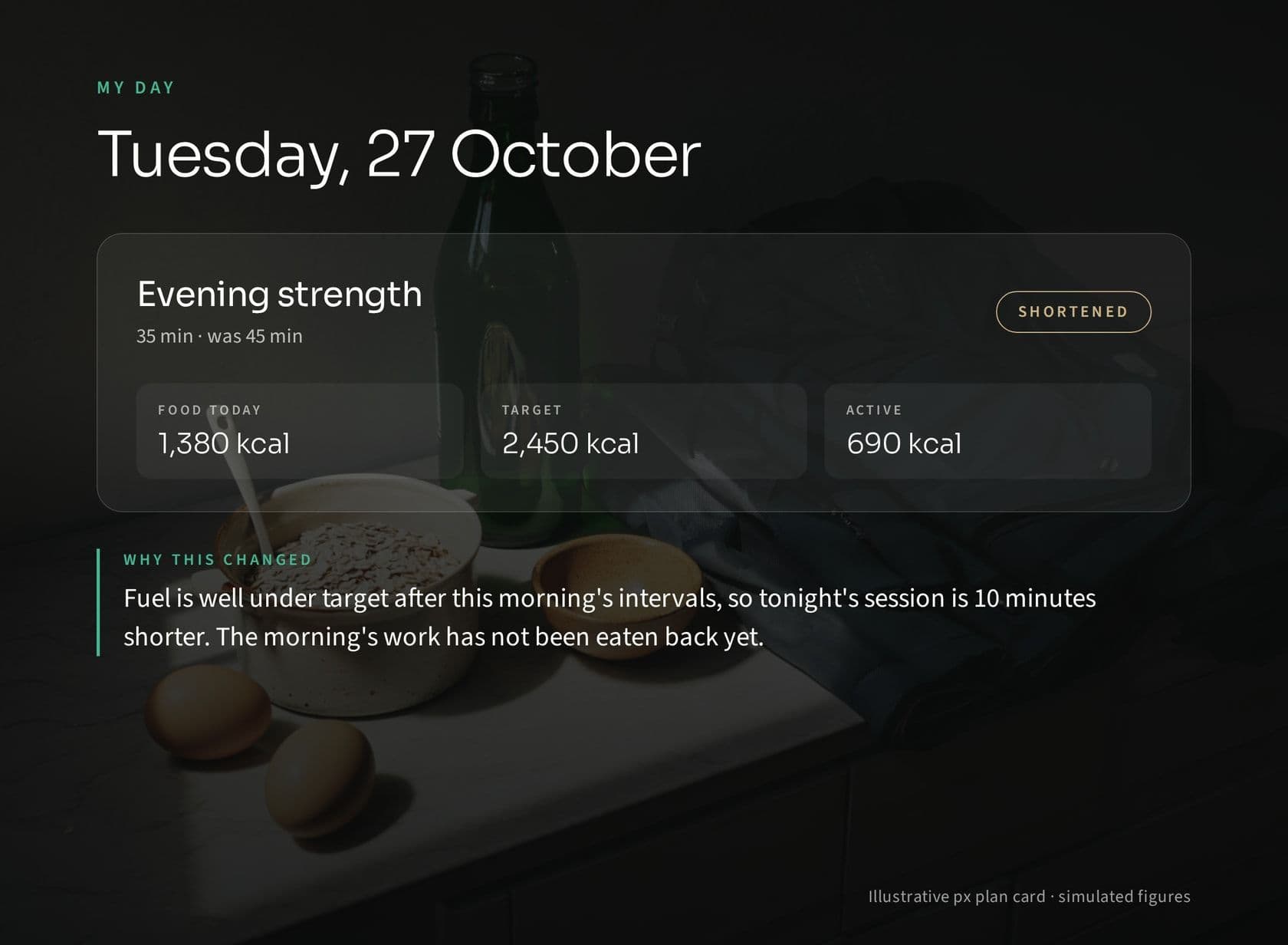
That card is the day's call, and it is all in one: a short day in Fuel changes Move and Mind before you reach the session, reason attached. If your goal involves a deficit, the target never goes below your resting metabolic rate, and the card says so. In a heavy work week, the coach's rule is regular meals and no restriction. If you describe cutting back hard and then eating well past it, px stops optimising your numbers. And when a nutrition claim online sounds certain, ask px: the coach looks up the evidence and tells you what the trials tested, never a dose.
Let today's training decide what you eat, not a list of rules. px turns everything that shapes your day into one plan for today, across training, mind and food, built around what you are pursuing. Try px
Frequently asked questions
Is clean eating healthy?
It depends which version you mean, because there is no agreed definition. Mostly minimally processed food, plenty of fruit and vegetables and enough protein is sound advice. The rules and exclusions version is the problem: it can leave you short on energy and carbohydrate on your hardest training days.
Do athletes need to avoid processed food?
No. UK advisers recommend less processed food that is high in energy, saturated fat, salt and free sugars and low in fibre, not avoiding everything processed. Before events, sport nutrition guidance favours foods low in fat and fibre. A bagel can be exactly the right food for the job.
What is the difference between a dietitian and a nutritionist?
In the UK, "dietitian" is protected by law and requires registration with the Health and Care Professions Council. "Nutritionist" is not, though qualified nutritionists can join the Association for Nutrition's voluntary register. In Australia anyone can call themselves a nutritionist, so look for an Accredited Practising Dietitian. In New Zealand, search the Dietitians Board's public register.
Can eating clean hurt athletic performance?
It can, through what it leaves out. Rules that forbid easy, energy-dense food make it harder to eat more when training asks for more, and the IOC links eating too little for the work to a weaker training response, slower recovery and lower strength, endurance and power.
Sources (19)
- Ambwani S, Sellinger G, Rose KL, Richmond TK, Sonneville KR. (2020). "It's Healthy Because It's Natural." Perceptions of "Clean" Eating among U.S. Adolescents and Emerging Adults. Nutrients, 12(6), 1708. https://doi.org/10.3390/nu12061708
- Ambwani S, Shippe M, Gao Z, Austin SB. (2019). Is #cleaneating a healthy or harmful dietary strategy? Perceptions of clean eating and associations with disordered eating among young adults. Journal of Eating Disorders, 7, 17. https://doi.org/10.1186/s40337-019-0246-2
- Allen M, Dickinson KM, Prichard I. (2018). The Dirt on Clean Eating: A Cross Sectional Analysis of Dietary Intake, Restrained Eating and Opinions about Clean Eating among Women. Nutrients, 10(9), 1266. https://doi.org/10.3390/nu10091266
- Porteous K, Kemps E, Powell A, Prichard I. (2026). "Eat Like Me = Look Like Me:" A Content Analysis of Healthy Lifestyle, Nutrition and Clean Eating Social Media Content. Journal of Technology in Behavioral Science. https://doi.org/10.1007/s41347-026-00685-5
- Mountjoy M, Ackerman KE, Bailey DM, et al. (2023). 2023 International Olympic Committee's (IOC) consensus statement on Relative Energy Deficiency in Sport (REDs). British Journal of Sports Medicine, 57(17), 1073 to 1098. https://doi.org/10.1136/bjsports-2023-106994
- Jenner SL, Buckley GL, Belski R, Devlin BL, Forsyth AK. (2019). Dietary Intakes of Professional and Semi-Professional Team Sport Athletes Do Not Meet Sport Nutrition Recommendations: A Systematic Literature Review. Nutrients, 11(5), 1160. https://doi.org/10.3390/nu11051160
- Thomas DT, Erdman KA, Burke LM. (2016). Position of the Academy of Nutrition and Dietetics, Dietitians of Canada, and the American College of Sports Medicine: Nutrition and Athletic Performance. Journal of the Academy of Nutrition and Dietetics, 116(3), 501 to 528. https://doi.org/10.1016/j.jand.2015.12.006
- Westenhoefer J, Stunkard AJ, Pudel V. (1999). Validation of the flexible and rigid control dimensions of dietary restraint. International Journal of Eating Disorders, 26(1), 53 to 64. https://doi.org/10.1002/%28SICI%291098-108X%28199907%2926:1%3C53::AID-EAT7%3E3.0.CO;2-N
- Smith CF, Williamson DA, Bray GA, Ryan DH. (1999). Flexible vs. Rigid Dieting Strategies: Relationship with Adverse Behavioral Outcomes. Appetite, 32(3), 295 to 305. https://doi.org/10.1006/appe.1998.0204
- Stewart TM, Williamson DA, White MA. (2002). Rigid vs. flexible dieting: association with eating disorder symptoms in nonobese women. Appetite, 38(1), 39 to 44. https://doi.org/10.1006/appe.2001.0445
- Hall KD, Ayuketah A, Brychta R, et al. (2019). Ultra-Processed Diets Cause Excess Calorie Intake and Weight Gain: An Inpatient Randomized Controlled Trial of Ad Libitum Food Intake. Cell Metabolism, 30(1), 67 to 77. https://doi.org/10.1016/j.cmet.2019.05.008
- Scientific Advisory Committee on Nutrition. (2025). Processed foods and health: SACN's rapid evidence update. Office for Health Improvement and Disparities. https://www.gov.uk/government/publications/processed-foods-and-health-sacns-rapid-evidence-update
- Denniss E, Lindberg R, McNaughton SA. (2023). Quality and accuracy of online nutrition-related information: a systematic review of content analysis studies. Public Health Nutrition, 26(7), 1345 to 1357. https://doi.org/10.1017/S1368980023000873
- Sabbagh C, Boyland E, Hankey C, Parrett A. (2020). Analysing Credibility of UK Social Media Influencers' Weight-Management Blogs: A Pilot Study. International Journal of Environmental Research and Public Health, 17(23), 9022. https://doi.org/10.3390/ijerph17239022
- Health and Care Professions Council. The professions we regulate. https://www.hcpc-uk.org/about-us/who-we-regulate/the-professions/
- Association for Nutrition. (2026). Check the Title: Why is the AfN a recognised regulator? https://www.associationfornutrition.org/latest-news/check-the-title-why-is-the-afn-a-recognised-regulator
- healthdirect Australia. Dietitians. https://www.healthdirect.gov.au/dietitians
- Dietitians Australia. Credentialing dietitians. https://dietitiansaustralia.org.au/working-dietetics/credentialing-dietitians
- Dietitians Board, New Zealand. Public register. https://www.dietitiansboard.org.nz/Public/Public/Public-Register/Public-Register.aspx
Worth passing on? Share it.
