Hydration and Nutrition for Heat Training, at Home or on the Road

Cameron Usher · Founder, px
· Updated · 10 min read
Twelve years in competitive sport, trained alongside the Australian Olympic squad. px is the coach he needed after ten coaches, every wearable and every protocol.
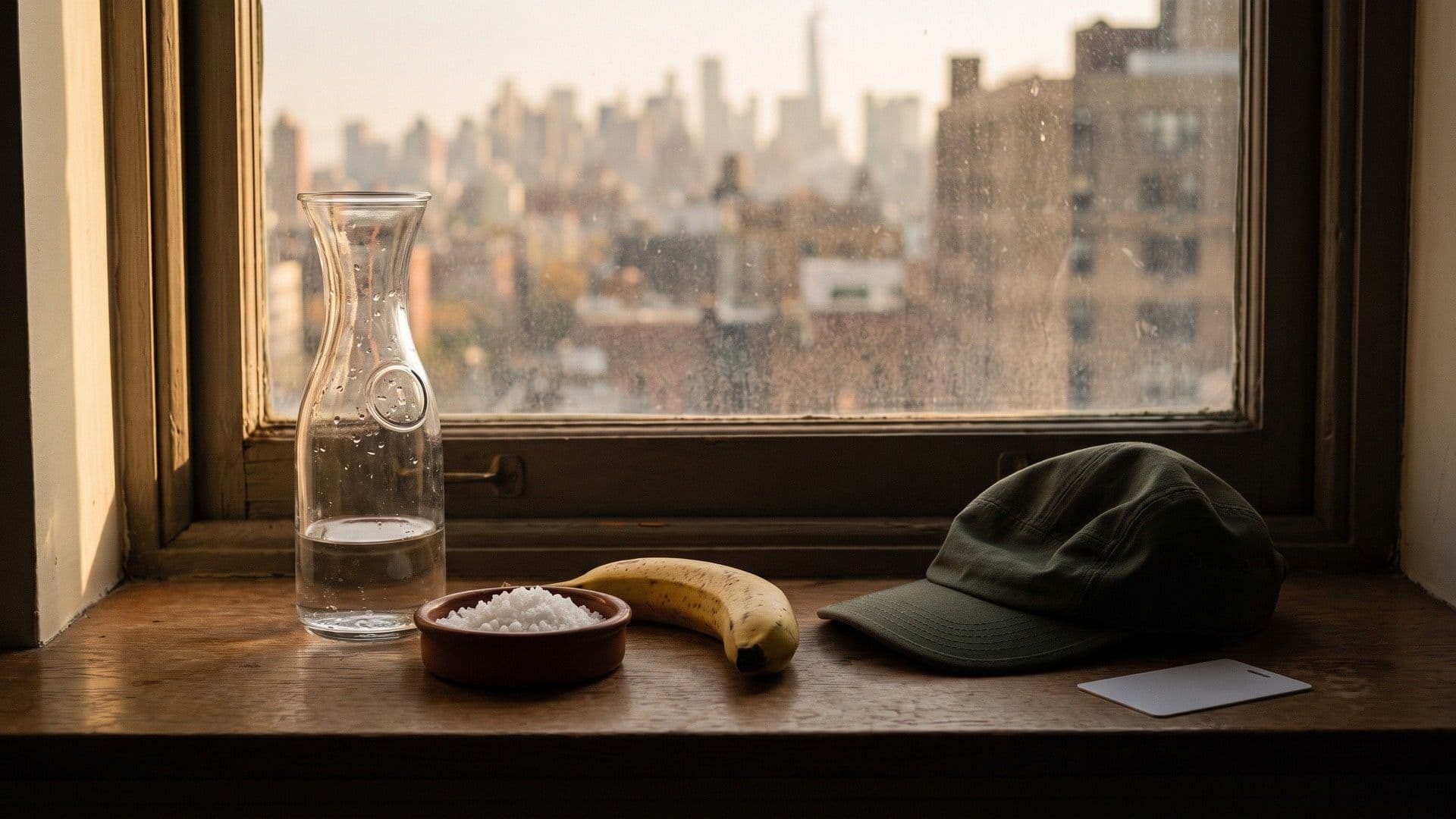
Hydration and nutrition for heat training, in short
Hydration and nutrition for heat training come down to measuring, not guessing. Weigh yourself before and after a session to learn your sweat rate; position stands advise keeping losses under about 2 per cent of body mass, and never gaining. Add sodium on long or hot sessions, carbohydrate past an hour, and eat on local time when travelling.
It is 6am, already 27°C, and you have a long run to fit in before a flight. You drink a litre at the sink because someone once told you to, and still finish with a headache and a shirt you could wring out. The guessing was the problem.
Hydration and nutrition for heat training is simpler than the advice around it. Find your own sweat rate with a scale. The position stands set the limit at about 2 per cent of body mass lost, and no weight gained. Put sodium with your fluid on long or hot sessions and carbohydrate into anything over an hour. On the road the same rules hold. The plane matters less than you think. The routine matters more.
How much water do you need when training in the heat?
There is no single number. The American College of Sports Medicine's position stand on fluid replacement puts athletes' sweat rates at 0.5 to 2.0 litres an hour, with sweat sodium averaging about 35 mmol per litre across a range of 10 to 70 (Sawka et al., 2007). A fourfold spread in water, and sevenfold in salt.
A large dataset agrees. Across 1,303 athletes, endurance athletes averaged 1.28 litres an hour with a standard deviation of 0.57 (Barnes et al., 2019). The data come from a sports drink company's research institute; the spread is the point either way.
This is also where "eight glasses a day" ends. Heinz Valtin found no evidence behind it, and was clear that his conclusion covered sedentary adults in temperate climates, not hard exercise in heat (Valtin, 2002). The heat answer is not a bigger rule. It is your own number.
How do you work out your sweat rate?
Weigh yourself before and after a session. It is the position stand's method, and body mass change is the most accurate field measure of whole-body sweat rate (Baker, 2017). A 2026 study of 23 recreationally active adults cycling in the heat used the scale as its reference, and a sweat rate calculator underestimated their losses (Bandiera et al., 2026). The scale wins.
- Weigh yourself before the session, after the loo, in minimal clothing.
- Train for about an hour in the conditions you care about. The number only describes that weather.
- Note exactly what you drink. It goes back into the sum.
- Skip the loo if you can. The sum assumes only sweat left your body.
- Towel dry and weigh again, in the same clothing, before you eat or drink.
- Add what you drank to what you lost. One kilogram is about one litre of sweat. Divide the loss by your starting weight for the percentage.
Worked example (illustrative numbers). You weigh 72.0 kg before a 60-minute run at 29°C. You drink 0.5 litres. Afterwards you weigh 71.0 kg. So you sweated about 1.5 litres in the hour. The 1.0 kg you did not replace is 1.4 per cent of your body mass, under the 2 per cent line. The free sweat rate calculator does the same sum.
Reading the result:
- Under about 2 per cent: your drinking matched the session. Keep it.
- Over 2 per cent on a long session: drink more next time, planned from your sweat rate.
- Heavier after than before: you drank more than you sweated. Fix this one first. The 2015 consensus on exercise-associated hyponatraemia, a dangerous fall in blood sodium, names drinking beyond your losses as its single most important risk factor (Hew-Butler et al., 2015).
Repeat the check when conditions change. Baker lists intensity, climate, heat acclimatisation, fitness, body composition, sex and diet among the factors that move sweat rate and sodium. A May test will not describe August. Acclimatisation itself is in our guide to pacing and acclimatising in the heat.
Heat · the sweat rate check
One number replaces every rule
Illustrative worked example · a 60-minute run at 29°C
Step 1
Before
Weigh yourself after the loo, in minimal clothing.
Example: 72.0 kg
Step 2
What you drank
Note exactly what you drink. It goes back into the sum.
Example: 0.5 L
Step 3
After
Towel dry and weigh again, in the same clothing, before you eat or drink.
Example: 71.0 kg
Step 4
Lost + drank = sweat
One kilogram is about one litre of sweat.
Example: About 1.5 L in the hour
Read the result · body mass lost
Under about 2 per cent
Keep it
Your drinking matched the session. The worked example lands here: the 1.0 kg not replaced is 1.4 per cent.
Over 2 per cent on a long session
Drink more
Next time, planned from your sweat rate.
Heavier after than before
Drink less
You drank more than you sweated. Fix this one first.
The heat answer is not a bigger rule. It is your own number.
Should you drink to thirst or follow a plan?
Both, depending on the session. The 2023 IOC consensus on sport in the heat calls it a live debate (Racinais et al., 2023).
For thirst: Goulet's meta-analysis of 15 studies and 122 participants found that in time trials, the lab test closest to racing, losses up to about 4 per cent of body mass did not measurably impair performance. Fixed-intensity tests showed a cost of about 1.9 per cent (Goulet, 2013). The hyponatraemia consensus calls drinking when thirsty the safest individual strategy.
For a plan: Kenefick's review sets out where thirst falls short, in sessions beyond about 90 minutes to 2 hours, at higher intensity, in warm or hot conditions (Kenefick, 2018). There, a planned amount that keeps you within about 2 per cent of body mass either way works. The position stand rates losses past 2 per cent as able to degrade aerobic performance, especially in heat.
So "if you are thirsty, you are already dehydrated" gets it backwards. Thirst is the signal working, not proof of harm. On short or cool sessions, follow it. On long, hot ones, follow a plan from your sweat check, practised in training in similar conditions, as the IOC advises.
Do you need electrolytes in hot weather?
On long sessions with heavy sweating, sodium earns its place. The position stand says electrolyte and carbohydrate drinks can beat water alone "under certain circumstances", and that sodium in drinks and snacks afterwards speeds recovery by stimulating thirst and helping you keep the fluid. The IOC consensus builds sodium into the drinking plan.
Two limits. Sodium does not make overdrinking safe: the hyponatraemia panel states that sports drinks will not prevent it in people who overdrink. And with sweat sodium varying sevenfold, there is no universal amount. Neither px nor this post will hand you a dose. Salty food at meals and a sodium drink on the longest, hottest days are the evidence-backed moves; a personal figure is a sports dietitian's job.
What should you eat and drink before, during and after a hot session?
Heat changes the fuel mix. In nine trained cyclists riding 90 minutes at 35°C and at 16°C, muscle glycogen use in the final 30 minutes was 25 per cent higher in the heat, and less of the carbohydrate they drank was used (Jentjens et al., 2002). In heat, arriving fed matters more, not less.
Cold helps, with a caveat. In 10 men, ice slurry before running in the heat extended time to exhaustion to 50.2 minutes against 40.7 with cold water (Siegel et al., 2010). During exercise, cold drinks briefly reduce sweating, which cancels out the extra cooling unless the air is hot, humid and still (Morris and Jay, 2018). Cool drinks of 10 to 15°C do lead people to drink more, the IOC consensus notes. Cold before, cool and palatable during.
| Hot session | Fluid | Food | Why |
|---|---|---|---|
| Before | Drink normally through the day; a cold drink or ice slurry before you start | Your usual carbohydrate-based meal a few hours out | Start topped up; heat spends more stored carbohydrate |
| During, under an hour | Drink to thirst | Usually nothing | Thirst covers shorter sessions (Kenefick, 2018) |
| During, over an hour or hot and hard | A planned amount from your sweat check, with sodium, kept cool | Carbohydrate; the IOC consensus cites 30 to 60 g an hour for exercise over an hour, in dilute form | Thirst can undershoot on long, hot sessions (Kenefick, 2018) |
| After | Replace over the next hours; the position stand's figure for fast recovery is about 1.5 litres per kg lost | A normal meal with carbohydrate, protein and salt | Sodium helps you keep what you drink |
Take Priya as a scenario: a two-hour run in a heatwave, eight weeks from her marathon. The first long run gets the sweat check; the second, a plan built from it. If she moves it to dawn, what to eat before an early session comes with it.
A hot week is one input into a training nutrition plan built around your actual load.
How do you stay hydrated and eat well when travelling for work?
Start with a myth. The UK Civil Aviation Authority puts cabin humidity at 10 to 20 per cent and states that it does not cause dehydration: the extra water lost on an eight-hour flight is about 150 ml. The dry air dries your mouth, which feels like thirst. A 2020 review found few studies on travelling athletes and no real evidence on how much flight dehydration affects performance (Zubac et al., 2020). Contested, and thin.
What dehydrates a traveller is the routine. Drinks skipped to avoid the aisle. A day in air conditioning, then a run at 35°C. Breakfast missed for an early call.
- Drink normally, and count coffee and tea. In a trial of 72 men, coffee and tea produced no more urine than water over four hours; milk was retained better (Maughan et al., 2016).
- Eat on local time from the first meal. Shifting meals five hours later moved the blood glucose rhythm by about 5.7 hours in 10 young men, without moving melatonin, the marker of the brain's master clock (Wehrens et al., 2017). One small lab trial: a sensible nudge, not a fix for jet lag.
- Choose food that travels safely. Travellers' diarrhoea affects 20 to 60 per cent of travellers from high-income countries visiting low-income areas (NaTHNaC, 2025). Food cooked fresh and served piping hot, fruit you peel yourself, pasteurised dairy and sealed drinks are safer. Buffets left out in warmth, raw shellfish, and ice where sanitation is poor are riskier.
- Build the hotel or airport plate like home: a protein, a carbohydrate, fruit or vegetables. Our guide to fast meals that survive a packed week has the assembly version.
Take Tom as a scenario: three days of meetings in Singapore, then a red-eye home. He keeps one real session and shortens the rest, as our training plan for busy professionals advises. After the red-eye he checks whether to train after a short night, and plans breakfast knowing what a short night does to food cravings.
What does px do on a hot day or a work trip?
With location permission, px reads the forecast, flags extreme heat on an outdoor session and offers an earlier, later or indoor option. px keeps a daily water guide based on your body weight. The coach quotes it as a guide, never a prescription, and will never push you to drink past thirst. On a long or hot session, the nudge is to add electrolytes (sodium) rather than water alone.
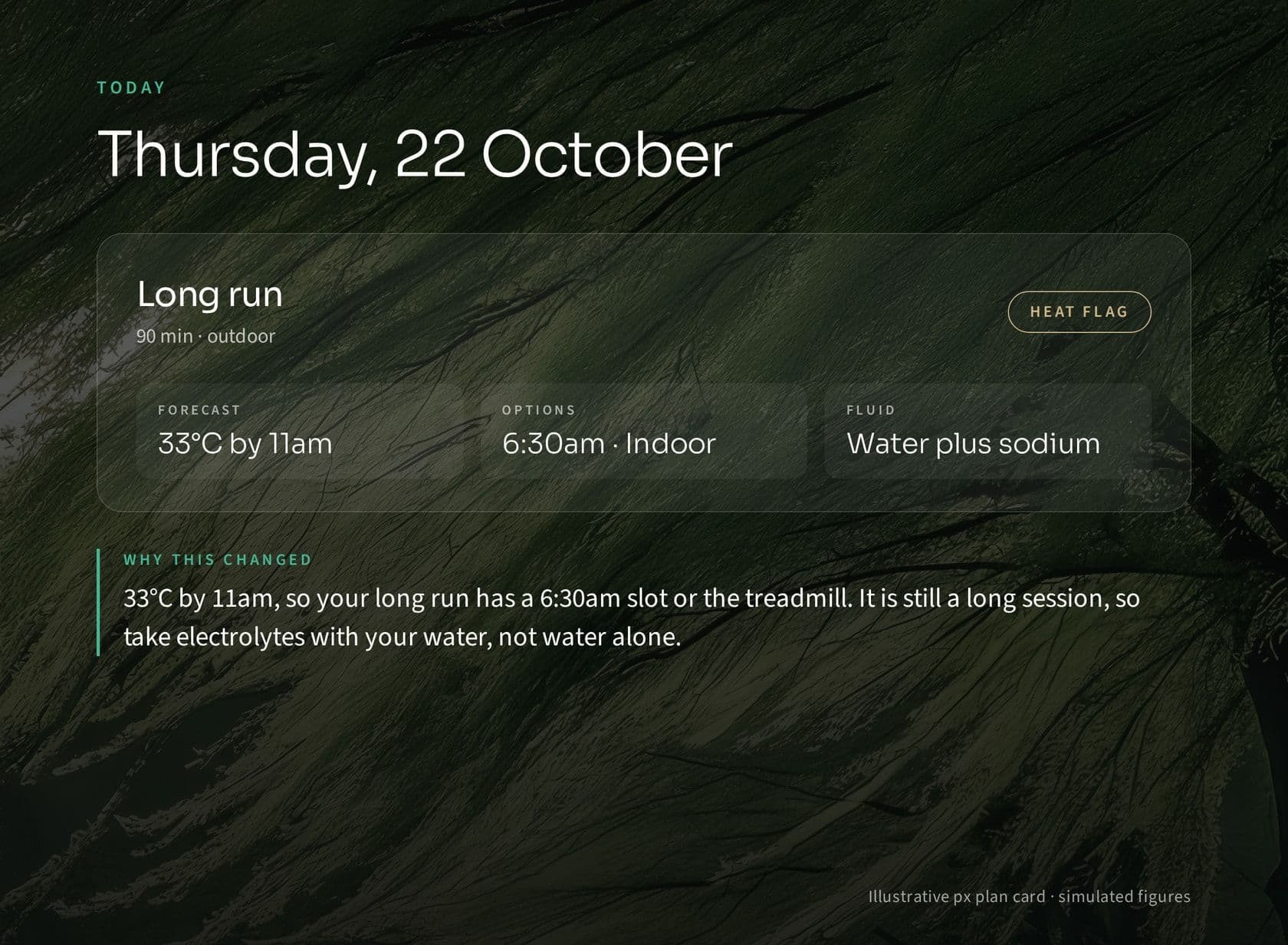
A plan card on a hot morning reads like this (illustrative): "33°C by 11am, so your long run has a 6:30am slot or the treadmill. It is still a long session, so take electrolytes with your water, not water alone."
On the road, travel mode, set from a check-in and even for a future day, shapes the coaching tone and the equipment your sessions assume. Flights on your calendar reach the coach as a category, never the event title, so you can plan the trip in conversation. The coach helps you eat out well, and if you are somewhere with amazing food, its advice is simple: eat it.
What px does not do: the app does not measure your sweat rate, and neither your water guide nor your food targets change for heat or travel. Two weigh-ins and the free sweat rate calculator cover the first. Ask px covers the second.
Hot week or work trip, the plan is built around it. px turns everything that shapes your day into one plan for today, across training, mind and food, built around what you are pursuing. Try px
Frequently asked questions
How much water should I drink when training in hot weather?
There is no single figure. Sweat rates run from 0.5 to 2.0 litres an hour (ACSM, 2007), so weigh yourself before and after a hot session and add what you drank. Under an hour, thirst usually covers it. For longer, hotter sessions, the position stands aim to keep losses under about 2 per cent of body mass, and never to drink so much that you weigh more afterwards.
Does clear urine mean I am well hydrated?
Not on its own. Urine colour tracked body water fairly well in a small lab study (Armstrong et al., 1998), but in a 2025 study of 24 adults one marker alone did not accurately identify dehydration. Two or three together did: body mass down, darker urine, thirst (Keefe et al., 2025). Treat colour as one clue among three.
Does flying dehydrate you?
Less than its reputation suggests. The UK Civil Aviation Authority states that cabin humidity of 10 to 20 per cent does not cause dehydration, and puts the extra water lost on an eight-hour flight at about 150 ml. The dry air dries your mouth, which feels like thirst. Skipped drinks, missed meals and landing into heat matter more. Drink to thirst, and count coffee and tea.
Do I need electrolytes for an hour-long run in the heat?
It depends on your sweat. The position stand says electrolyte drinks help "under certain circumstances", and long, hot sessions with heavy sweating are where the evidence points. If your sweat check shows a high rate, sodium with your water makes sense, and salty food afterwards helps you keep the fluid. It cannot make drinking far past thirst safe.
Sources (19)
- Sawka MN, Burke LM, Eichner ER, Maughan RJ, Montain SJ, Stachenfeld NS (American College of Sports Medicine). (2007). American College of Sports Medicine position stand. Exercise and fluid replacement. Medicine and Science in Sports and Exercise, 39(2), 377 to 390. https://doi.org/10.1249/mss.0b013e31802ca597
- Racinais S, Hosokawa Y, Akama T, et al. (2023). IOC consensus statement on recommendations and regulations for sport events in the heat. British Journal of Sports Medicine, 57, 8 to 25. https://doi.org/10.1136/bjsports-2022-105942
- Baker LB. (2017). Sweating rate and sweat sodium concentration in athletes: a review of methodology and intra/interindividual variability. Sports Medicine, 47(Suppl 1), 111 to 128. https://doi.org/10.1007/s40279-017-0691-5
- Barnes KA, Anderson ML, Stofan JR, Dalrymple KJ, Reimel AJ, Roberts TJ, Randell RK, Ungaro CT, Baker LB. (2019). Normative data for sweating rate, sweat sodium concentration, and sweat sodium loss in athletes: an update and analysis by sport. Journal of Sports Sciences, 37(20), 2356 to 2366. https://doi.org/10.1080/02640414.2019.1633159
- Bandiera D, de Bardonnèche J, Margout-Jantac D, Dubois L, El Allaoui N, Rubio JSE, Aubin J-C, Racinais S, Tessitore A, Pitsiladis Y. (2026). Sweat sodium composition and sweat loss estimation through wearable sensors and predictive equations in dry and humid hot conditions. Frontiers in Physiology, 16, 1717275. https://doi.org/10.3389/fphys.2025.1717275
- Hew-Butler T, Rosner MH, Fowkes-Godek S, et al. (2015). Statement of the Third International Exercise-Associated Hyponatremia Consensus Development Conference, Carlsbad, California, 2015. Clinical Journal of Sport Medicine, 25(4), 303 to 320. https://doi.org/10.1097/JSM.0000000000000221
- Valtin H. (2002). "Drink at least eight glasses of water a day." Really? Is there scientific evidence for "8 x 8"? American Journal of Physiology: Regulatory, Integrative and Comparative Physiology, 283(5), R993 to R1004. https://doi.org/10.1152/ajpregu.00365.2002
- Goulet EDB. (2013). Effect of exercise-induced dehydration on endurance performance: evaluating the impact of exercise protocols on outcomes using a meta-analytic procedure. British Journal of Sports Medicine, 47(11), 679 to 686. https://doi.org/10.1136/bjsports-2012-090958
- Kenefick RW. (2018). Drinking strategies: planned drinking versus drinking to thirst. Sports Medicine, 48(Suppl 1), 31 to 37. https://doi.org/10.1007/s40279-017-0844-6
- Jentjens RLPG, Wagenmakers AJM, Jeukendrup AE. (2002). Heat stress increases muscle glycogen use but reduces the oxidation of ingested carbohydrates during exercise. Journal of Applied Physiology, 92(4), 1562 to 1572. https://doi.org/10.1152/japplphysiol.00482.2001
- Siegel R, Maté J, Brearley MB, Watson G, Nosaka K, Laursen PB. (2010). Ice slurry ingestion increases core temperature capacity and running time in the heat. Medicine and Science in Sports and Exercise, 42(4), 717 to 725. https://doi.org/10.1249/MSS.0b013e3181bf257a
- Morris NB, Jay O. (2018). Does cold water or ice slurry ingestion during exercise elicit a net body cooling effect in the heat? Sports Medicine, 48(Suppl 1), 17 to 29. https://doi.org/10.1007/s40279-017-0842-8
- UK Civil Aviation Authority. Physiology of flight: guidance for health professionals. https://www.caa.co.uk/air-passengers/about-your-trip/health-and-medical/guidance-for-health-professionals/physiology-of-flight/ (accessed 29 September 2026)
- Zubac D, Buoite Stella A, Morrison SA. (2020). Up in the air: evidence of dehydration risk and long-haul flight on athletic performance. Nutrients, 12(9), 2574. https://doi.org/10.3390/nu12092574
- Maughan RJ, Watson P, Cordery PA, Walsh NP, Oliver SJ, Dolci A, Rodriguez-Sanchez N, Galloway SD. (2016). A randomized trial to assess the potential of different beverages to affect hydration status: development of a beverage hydration index. American Journal of Clinical Nutrition, 103(3), 717 to 723. https://doi.org/10.3945/ajcn.115.114769
- Wehrens SMT, Christou S, Isherwood C, Middleton B, Gibbs MA, Archer SN, Skene DJ, Johnston JD. (2017). Meal timing regulates the human circadian system. Current Biology, 27(12), 1768 to 1775.e3. https://doi.org/10.1016/j.cub.2017.04.059
- National Travel Health Network and Centre (NaTHNaC). (2025). Food and water hygiene. TravelHealthPro, updated 23 October 2025. https://travelhealthpro.org.uk/factsheets/food-and-water-hygiene
- Armstrong LE, Soto JA, Hacker FT, Casa DJ, Kavouras SA, Maresh CM. (1998). Urinary indices during dehydration, exercise, and rehydration. International Journal of Sport Nutrition, 8(4), 345 to 355. https://doi.org/10.1123/ijsn.8.4.345
- Keefe MS, Luk H-Y, Rolloque J-J, Jiwan NC, Sekiguchi Y. (2025). Hydration assessment in males and females using the WUT (weight, urine color, and thirst) Venn diagram compared to blood and urinary indices. Nutrients, 17(4), 689. https://doi.org/10.3390/nu17040689
Worth passing on? Share it.
