Sleep Deprivation and Food Cravings: Why a Short Night Changes What You Reach For

Cameron Usher · Founder, px
· 10 min read
Twelve years in competitive sport, trained alongside the Australian Olympic squad. px is the coach he needed after ten coaches, every wearable and every protocol.

Sleep deprivation and food cravings, in short
After a short night you eat more, roughly 250 to 385 kcal a day in lab studies, and the extra shifts towards energy-dense, rewarding food later in the day. Reward and self-control circuits explain it better than leptin and ghrelin. The fix is a plan made in the morning, not willpower in the afternoon.
It is 3:40pm. You slept five hours, the broken kind. You are not especially hungry, yet you are back in the kitchen for the second time since lunch, and the voice in your head has already filed it under weak.
It is not weakness. The link between sleep deprivation and food cravings is one of the more consistent findings in nutrition research. After a short night you eat more, on average a few hundred kcal a day in lab studies, and the extra shifts towards energy-dense, rewarding food and towards the back half of the day. Reward and self-control systems explain it better than a simple hormone switch. The answer is a plan made in the morning, not willpower in the afternoon.
Does lack of sleep really make you eat more?
Yes, measurably. A 2017 meta-analysis pooled 11 controlled trials (172 people) and found partial sleep deprivation raised energy intake by 385 kcal a day (95% confidence interval 252 to 517), with no significant change in energy expenditure. A larger 2019 meta-analysis of 41 randomised trials in healthy adults put the rise at 253 kcal a day, with hunger up 13.4 mm on a 100 mm scale. Tired and hungry is not in your head.
Some of that hunger is honest, because being awake longer costs energy. In an inpatient study of 16 young adults on five-hour nights for five days, total daily energy expenditure rose by about 5 per cent, roughly 111 kcal. The authors read the extra appetite as an adaptation to fund extra wakefulness, one that overshoots when food is easy to reach. A 2023 review in Nature Reviews Endocrinology gives the same shape: about 100 kcal more spent, more than 250 kcal more eaten. So the goal is not to eat less than normal. It is to eat what the day needs, without the overshoot.
These are averages. In a 2024 crossover, 96 adults spent one night without sleep and showed no difference in hunger or in how much they ate when eating to fullness. Not every night does this to everyone; enough do to be worth a plan.
Is it just leptin and ghrelin?
The usual story about sleep and appetite: short sleep lowers leptin, which signals fullness, and raises ghrelin, which signals hunger. It traces to a 2004 study in which 12 healthy young men given two short nights showed leptin down 18 per cent, ghrelin up 28 per cent, hunger up 24 per cent, and appetite for calorie-dense, high-carbohydrate foods up 33 to 45 per cent. That last figure is where "short sleep makes you crave carbs" comes from. It was a rating of appetite, not food eaten, in a small two-night study.
The story did not replicate reliably. The 2019 meta-analysis of 41 trials found no strong evidence that sleep restriction moves average leptin or ghrelin, and a small 2025 meta-analysis of six trials found no significant change in either. In the five-night study, people ate more despite hormone changes that signalled plenty of stored energy. In a study of 32 men, one form of ghrelin rose after a night without sleep but did not track how much they valued food. A 2026 review puts it carefully: some studies, but not all, find the hormone shift.
The hormones matter less than the story claims. The 2023 review says the excess intake is more related to cognitive control and reward mechanisms than to appetite hormones.
What actually drives the craving?
Wanting, more than hunger.
The brain weighs food differently. In a 2013 imaging study of 23 young adults, one night without sleep quietened the frontal and insular regions that evaluate food choices and turned up the amygdala. The high-calorie items people wanted added up to about 600 kcal more. Reported hunger did not change.
Food is worth more to you. In the 2019 study of 32 men, a night without sleep made participants willing to pay more for food, again with hunger unchanged.
A reward signal runs longer. A 2016 crossover of 14 young adults compared four nights of 8.5 hours in bed with four of 4.5. Short sleep amplified the daily rhythm of 2-AG, an endocannabinoid linked to the reward side of eating, by about a third, moved its peak from roughly 12:30pm to 2:30pm, and it tended to stay high into the evening. Participants were less able to hold back from palatable snacks after a meal covering about 90 per cent of their daily needs, though the difference in snack calories was only a trend.
This is why willpower is the wrong frame. At 3:40pm after a short night, you are choosing with less of the machinery you normally use, against a louder reward signal. Trying harder asks the tired system to overrule itself. Decide earlier, before the reward signal peaks.
Is it really quick carbs, and why so late in the day?
"Quick carbs" is how it feels. The data are more specific.
The foods that grow are the energy-dense, rewarding ones, where sugar, starch and fat tend to arrive together. After one night with a third less time in bed, 24 women plated 12.4 per cent more energy at lunch, with bigger portions of white rice and crisps. Across trials, the 2017 meta-analysis found the extra intake came with more fat and less protein, and no change in carbohydrate, while the five-night study found carbohydrate did rise. The macronutrient shift varies by study. The pull towards palatable, easy food does not. And protein, the part of a meal with the best evidence for keeping you full, tends to slip.
The timing is the most consistent part.
| Study | Who | Sleep | When the extra eating landed |
|---|---|---|---|
| Markwald et al. 2013, PNAS | 16 adults | 5 nights, 5 h | Smaller breakfasts; after-dinner snacks up 42%, larger than any meal |
| Hanlon et al. 2016, Sleep | 14 adults | 4 nights, 4.5 h | Reward signal peak moved from about 12:30 to 2:30pm, high into the evening |
| Spaeth et al. 2013, Sleep | 225 adults (intake in 31) | 5 nights, 4 h | 553 extra kcal between 10pm and 4am, while awake |
A 2025 review sums it up: the extra intake lands mainly in the latter part of the day.
That refines the line in Training on Empty that short sleep drags appetite towards quick carbohydrate. The pull is real, but it is not specific to carbohydrate. It is towards any easy, rewarding food, later in the day, while protein slips.
Short sleep · across one day
When the pull peaks, and what the plan puts there
- 7amProtein breakfast
- 10amLunch and dinner decided
- 1pmLast coffee
- 2pmPlanned afternoon snack, before the peak
- 7pmDinner, then done
Illustrative
Every decision sits before the pull rises. Decide earlier, before the reward signal peaks.
What should you eat the day after a short night?
Normal food, decided early and placed ahead of the afternoon. Think of it as one day of a training nutrition plan built around your actual load. An if-then plan made in advance works better for adding a food than for resisting one: a meta-analysis of 23 studies found a medium effect for promoting healthy eating and a small one for cutting unhealthy eating (d = 0.51 against 0.29). No trial has tested these six steps as a package after a short night; each is built from the evidence above.
1. Morning: eat breakfast, anchored on protein
Eat even if appetite is flat, and build it on protein: eggs, Greek yoghurt, cottage cheese. Why: the lab pattern is a small breakfast and a large evening, and protein is what slips. Higher-protein meals produce more fullness than lower-protein ones in controlled tests, though those tests were short and not run after short sleep. If you train early, protein before a morning workout covers the timing.
2. Midday: decide lunch before you are at the counter
Choose lunch by mid-morning, with protein and a normal serving of carbohydrate. Why: after a short night, people plate bigger portions when they choose in the moment. At 10am, you are choosing before the afternoon pull arrives.
3. The afternoon window: plan the snack before the pull arrives
Put something you actually want into the 2 to 5pm window. If sweet is what you want, have it, with some protein. Why: this is when the reward signal peaks, and a planned food you are allowed is easier to follow than a craving you are refusing. Fibre alone is a weak bet: a review of acute trials could not show a fullness effect.
4. Training: ease the session, not the food
Size the session with the tiers in Training on Empty. Eat normally around it, carbohydrate included. Why: in people who train, inadequate sleep already weighs on appetite, energy intake and protein synthesis. An easier session trims what you need a little; it does not make today a day for going short.
5. Evening: dinner decided at breakfast
Know what dinner is before lunch, and keep it quick; fast meals for a packed training week are built for this. After a late session, carbohydrate at dinner is on the plan, not the thing to cut, which is the same call made in sleeping after an evening workout. Why: after dinner is where the extra eating lands, and a dinner that is decided, satisfying and finished leaves less room for drift. Nothing is forbidden, because a stricter plan is not the same as fuelling well.
6. Protecting tonight: stop caffeine early, go to bed earlier
Front-load coffee, stop by early afternoon, and aim for a full night. Why: a 2023 meta-analysis of 24 studies found caffeine cut total sleep by 45 minutes on average and put the cut-off for a standard coffee at 8.8 hours before bed. Tonight is the real fix: when the five-night study returned people to full nights, intake fell.
What if the short nights keep coming?
Then the lever moves upstream. In a 2022 randomised trial in JAMA Internal Medicine, 80 adults who habitually slept under six and a half hours got sleep counselling at home. They slept 1.2 hours more a night and ate about 270 kcal a day less, measured objectively. The trial recruited adults in the overweight range, so take the direction, not the size. It targeted sleep, not food.
A heavy work week draws on the same recovery account as short nights; how work stress shows up in your HRV explains why the plan reads them together.
What px changes after a short night
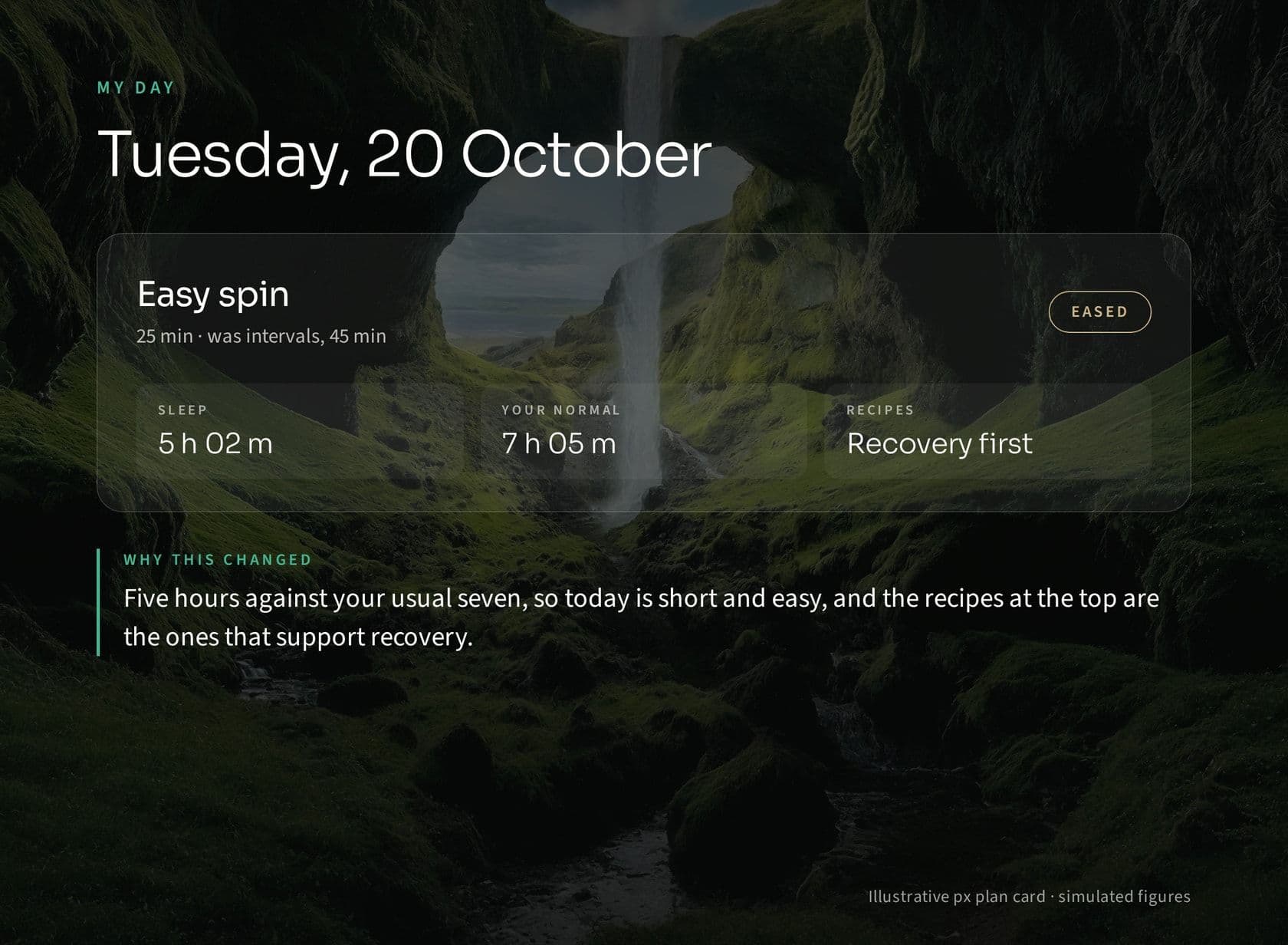
px reads the same night and changes training and food together. The Move side eases: the sleep-debt rule sizes the day down to short and easy. If you slept under six hours and at least 15 per cent under your own normal, the morning briefing can carry an adjustment card that says what changed and why.
Fuel moves on the same night. Under six hours, the coach trims the extra calories it adds for training by a fifth, in step with the easier session; the rest of the day's target does not come down. If your goal has you eating in a deficit and sleep quality came in poor, px halves the deficit and says why: so recovery is not fighting calorie stress on top of sleep stress. When recovery is low, recipe ranking leans towards ones marked as supporting recovery today; when it has collapsed, px caps the cooking time. The coach is built not to moralise food. Ask px for tonight's dinner at breakfast and it can book the recipe into your day.
One night, two pillars, one reason:
"Five hours against your usual seven, so today is short and easy, and the recipes at the top are the ones that support recovery."
Decide the afternoon before it arrives. px reads what you already track and builds one plan across training, mind and food before your day starts. Try px
Frequently asked questions
Why am I so hungry after a bad night's sleep?
Partly because being awake longer costs energy, roughly 100 kcal a day in lab studies. Mostly because short sleep makes food more rewarding: the brain regions that weigh food choices quieten, reward signals run louder and later, and intake rises by roughly 250 to 385 kcal a day on average. In several studies people wanted more high-calorie food without feeling hungrier.
Does lack of sleep cause sugar cravings?
It raises the pull towards energy-dense, rewarding food, and sweet food is part of that. The well-known 2004 study found appetite for calorie-dense, high-carbohydrate foods rose 33 to 45 per cent in 12 young men. Across trials, though, the extra intake shows up as snack food generally, with more fat and less protein. It is a reward and timing problem more than a sugar problem.
Should I eat less the day after a short night?
No. Being awake longer raises energy expenditure slightly, and sleep loss already weighs on recovery, so going short on top of it makes the day harder, not easier. Eat what the day needs, anchor meals on protein, plan an afternoon snack you actually want, and fuel any session normally. Aim at the overshoot, not the food the day needs.
How long does the effect last?
In lab studies it tracks the sleep. When people moved from five-hour nights back to full nights, their intake came down, especially fat and carbohydrate. In a 2022 trial, habitual short sleepers who slept 1.2 hours more a night ate about 270 kcal a day less. The fastest route back is sleep itself, which is why protecting tonight is the plan's last step.
Sources (20)
- Al Khatib HK, Harding SV, Darzi J, Pot GK. (2017). The effects of partial sleep deprivation on energy balance: a systematic review and meta-analysis. European Journal of Clinical Nutrition, 71(5), 614-624. https://doi.org/10.1038/ejcn.2016.201
- Zhu B, Shi C, Park CG, Zhao X, Reutrakul S. (2019). Effects of sleep restriction on metabolism-related parameters in healthy adults: a comprehensive review and meta-analysis of randomized controlled trials. Sleep Medicine Reviews, 45, 18-30. https://doi.org/10.1016/j.smrv.2019.02.002
- Chaput J-P, McHill AW, Cox RC, Broussard JL, Dutil C, da Costa BGG, Sampasa-Kanyinga H, Wright KP Jr. (2023). The role of insufficient sleep and circadian misalignment in obesity. Nature Reviews Endocrinology, 19(2), 82-97. https://doi.org/10.1038/s41574-022-00747-7
- Markwald RR, Melanson EL, Smith MR, Higgins J, Perreault L, Eckel RH, Wright KP Jr. (2013). Impact of insufficient sleep on total daily energy expenditure, food intake, and weight gain. Proceedings of the National Academy of Sciences, 110(14), 5695-5700. https://doi.org/10.1073/pnas.1216951110
- Spaeth AM, Dinges DF, Goel N. (2013). Effects of experimental sleep restriction on weight gain, caloric intake, and meal timing in healthy adults. Sleep, 36(7), 981-990. https://doi.org/10.5665/sleep.2792
- Tasali E, Wroblewski K, Kahn E, Kilkus J, Schoeller DA. (2022). Effect of sleep extension on objectively assessed energy intake among adults with overweight in real-life settings: a randomized clinical trial. JAMA Internal Medicine, 182(4), 365-374. https://doi.org/10.1001/jamainternmed.2021.8098
- Chan WS. (2024). Effects of sleep deprivation on food-related Pavlovian-instrumental transfer: a randomized crossover experiment. Scientific Reports, 14, 10029. https://doi.org/10.1038/s41598-024-60223-2
- Spiegel K, Tasali E, Penev P, Van Cauter E. (2004). Brief communication: sleep curtailment in healthy young men is associated with decreased leptin levels, elevated ghrelin levels, and increased hunger and appetite. Annals of Internal Medicine, 141(11), 846-850. https://doi.org/10.7326/0003-4819-141-11-200412070-00008
- Rihm JS, Menz MM, Schultz H, Bruder L, Schilbach L, Schmid SM, Peters J. (2019). Sleep deprivation selectively upregulates an amygdala-hypothalamic circuit involved in food reward. Journal of Neuroscience, 39(5), 888-899. https://doi.org/10.1523/JNEUROSCI.0250-18.2018
- Gresser D, McLimans K, Lee S, Morgan-Bathke M. (2025). The impact of sleep deprivation on hunger-related hormones: a meta-analysis and systematic review. Obesities, 5(2), 48. https://doi.org/10.3390/obesities5020048
- Rosenberg R, Breit MJ, Clark KC, Broussard JL, Catenacci VA, Depner CM, Simon SL, Wright KP Jr, Zuraikat FM, Creasy SA. (2026). Examining the role of sleep in body weight regulation and implications for obesity treatment: a narrative review. Obesity Reviews, 27(2), e70017. https://doi.org/10.1111/obr.70017
- Greer SM, Goldstein AN, Walker MP. (2013). The impact of sleep deprivation on food desire in the human brain. Nature Communications, 4, 2259. https://doi.org/10.1038/ncomms3259
- Hanlon EC, Tasali E, Leproult R, Stuhr KL, Doncheck E, de Wit H, Hillard CJ, Van Cauter E. (2016). Sleep restriction enhances the daily rhythm of circulating levels of endocannabinoid 2-arachidonoylglycerol. Sleep, 39(3), 653-664. https://doi.org/10.5665/sleep.5546
- Yang C-L, Schnepp J, Tucker RM. (2019). Increased hunger, food cravings, food reward, and portion size selection after sleep curtailment in women without obesity. Nutrients, 11(3), 663. https://doi.org/10.3390/nu11030663
- Cheng WY, Chan WS. (2025). A narrative review on sleep and eating behavior. Current Diabetes Reports, 25, 50. https://doi.org/10.1007/s11892-025-01611-4
- Doherty R, Madigan S, Warrington G, Ellis JG. (2024). Sleep and nutrition for athletes. Proceedings of the Nutrition Society, 85(1), 33-39. https://doi.org/10.1017/S0029665124007535
- Dhillon J, Craig BA, Leidy HJ, et al. (2016). The effects of increased protein intake on fullness: a meta-analysis and its limitations. Journal of the Academy of Nutrition and Dietetics, 116(6), 968-983. https://doi.org/10.1016/j.jand.2016.01.003
- Warrilow A, Mellor D, McKune A, Pumpa K. (2019). Dietary fat, fibre, satiation, and satiety: a systematic review of acute studies. European Journal of Clinical Nutrition, 73(3), 333-344. https://doi.org/10.1038/s41430-018-0295-7
- Adriaanse MA, Vinkers CDW, De Ridder DTD, Hox JJ, De Wit JBF. (2011). Do implementation intentions help to eat a healthy diet? A systematic review and meta-analysis of the empirical evidence. Appetite, 56(1), 183-193. https://doi.org/10.1016/j.appet.2010.10.012
- Gardiner C, Weakley J, Burke LM, Roach GD, Sargent C, Maniar N, Townshend A, Halson SL. (2023). The effect of caffeine on subsequent sleep: a systematic review and meta-analysis. Sleep Medicine Reviews, 69, 101764. https://doi.org/10.1016/j.smrv.2023.101764
Worth passing on? Share it.
