Nutrition for Injury Recovery: What to Eat When You Are Coming Back

Cameron Usher · Founder, px
15 October 2026 · 10 min read
Twelve years in competitive sport, trained alongside the Australian Olympic squad. px is the coach he needed after ten coaches, every wearable and every protocol.

Nutrition for injury recovery, in short
Nutrition for injury recovery is mostly about not under-eating. Energy needs fall less than you would expect when training drops, and a deficit makes muscle loss worse. Hold your usual protein and spread it across meals. No food or supplement has good evidence that it speeds an injury's recovery, and your clinician's plan comes first.
Your week used to hold four sessions. Now it holds two short rehab blocks and a thought that arrives around day three with total confidence: I am barely training, so I should barely eat.
That instinct is the most common mistake in nutrition for injury recovery, and the evidence runs the other way. Your energy needs fall less than it feels like they should. Eating well under them makes muscle loss worse. Protein belongs in every main meal, at the level you ate when you were training. And no food or supplement has good evidence that it makes an injury recover faster.
A note before we start. This is training nutrition, not treatment: no doses, no supplements to start, no timelines and nothing specific to one kind of injury. The plan from your physiotherapist or doctor comes first. If a dietitian is involved, or a medical condition shapes what you eat, their advice outranks everything below.

Should you eat less when you are injured and training less?
Less than you think, and never by cutting meals. The instinct is arithmetic: fewer sessions, fewer calories burned, fewer eaten.
Kevin Tipton put it plainly in a 2015 review. The fall in energy expenditure after an injury "is likely not as great as was first thought", and "the overall reduction may be less than appears obvious" (Tipton, 2015, Sports Medicine). And on crutches, the same review notes, walking takes two to three times the energy it normally does.
Under-eating is paid for in muscle. In a controlled study of 15 young adults, five days of eating well below their needs cut the resting rate of muscle protein synthesis, the process that builds and maintains muscle, by 27 per cent compared with eating to balance (Areta et al., 2014, Am J Physiol Endocrinol Metab). They were not even injured. Reviewing injury nutrition for track and field, Close and colleagues warn athletes not to under-fuel in recovery "through being too focused upon not gaining body fat" (Close et al., 2019, Int J Sport Nutr Exerc Metab).
The other half: Tipton is just as clear that a large surplus is not the goal. Aim for roughly balance, which looks like an easy training week, not a diet. Keep your meals. The extra carbohydrate you ate around long or hard sessions can come down with them, because carbohydrate needs rise and fall with training load (Thomas et al., 2016, Med Sci Sports Exerc). It is the logic of a training nutrition plan built around your actual load, on a week when the load is smaller.
And if a day without a session makes food feel unearned: food is not payment for training, and an injury is not a reason to put yourself on rations. Why you feel guilty for resting takes that feeling apart.
What happens to your muscle when you stop using it?
It goes faster than you would expect, and strength goes faster than size. Maastricht researchers put one leg of healthy young men in a full cast. After five days, the quadriceps had lost 3.5 per cent of their cross-sectional area and 9 per cent of their strength (Wall et al., 2014, Acta Physiologica; 12 men in the five-day group). After 14 days, in a related study of 12 men, muscle area was down 8.4 per cent and strength 22.9 per cent, and the muscle-building response to a standard serving of protein (20 g in the trial) had dropped by 31 per cent (Wall et al., 2013, J Clin Endocrinol Metab). Researchers call that anabolic resistance: muscle you are not using listens less to the protein you eat.
Take the shape, not the size: a full cast is a harder stop than most injuries force on you.
Injury recovery · where food fits
Where the muscle goes, and where food fits
Less use
The main driver in short studies
Wall 2013, 2014
Eating well under your needs
Adds to the loss
Areta 2014
Extra protein alone
No clear effect in short trials
Kilroe 2021; Hughes 2024
Load your clinician allows, with protein held
What rebuilds it
Morton 2018
All four act on
Muscle and strength
Food does not stop disuse loss. Eating well under your needs makes it worse. Protein earns its place when load returns.
Can more protein stop that muscle loss?
Not on its own. This is the myth worth correcting: double your protein when injured and the muscle will stay. Recent trials do not support it.
- In a 2021 randomised trial, 33 young men spent three days with a leg immobilised on 1.6, 0.5 or 0.15 g of protein per kilogram of bodyweight a day. Muscle volume fell 2.0 to 2.7 per cent in every group, and strength fell alike (Kilroe et al., 2021, Am J Clin Nutr).
- A 2024 meta-analysis of eight randomised trials in healthy adults on bed rest or with a limb immobilised found no effect of protein or amino acids on muscle loss (Hughes et al., 2024, Experimental Physiology).
- A 2023 meta-analysis of 20 trials and 339 people, pooling protein with several supplements, found a small effect on leg lean mass (moderate certainty) and none on strength (low certainty) (Ye et al., 2023, Frontiers in Nutrition).
Over the short windows studied, disuse drives the loss. The biggest lever is load: the rehab your clinician sets and the training on everything the injury does not own, which the Move guide on how to return to training after injury sets out.
Protein still matters, for two reasons. The American College of Sports Medicine's joint position says that after sudden inactivity from injury, higher protein spread over the day "may be advantageous in preventing fat-free mass loss" (Thomas et al., 2016). Note the "may". And when load returns, protein is what muscle builds with: across 49 trials and 1,863 healthy adults, protein alongside resistance training added to gains in size and strength (Morton et al., 2018, Br J Sports Med).
So keep protein where it was when you were training, spread through the day. Whether to go higher is a question for the person managing your injury.
How much protein do the reviews suggest, and when?
Read this as evidence, not as a number for you.
| Source | Built on | What it says | How strong |
|---|---|---|---|
| ISSN position stand (Jäger et al., 2017) | Healthy people who exercise | 1.4 to 2.0 g/kg a day; 20 to 40 g per meal, every 3 to 4 hours | Strong, not about injury |
| ACSM, AND and DC joint position (Thomas et al., 2016) | Athletes | 1.2 to 2.0 g/kg a day; after injury, "as high as 2.0 g/kg/day or higher" spread over the day "may be advantageous" | Strong, cautious on injury |
| Tipton, 2015 | Injury review | About 2 to 2.5 g/kg a day during immobilisation | Expert opinion |
| Smith-Ryan et al., 2020 | Injury review | At least 1.6, "closer to 2.0 to 3.0" g/kg a day | Expert opinion |
The injury reviews sit at or above the ranges for healthy exercisers, and none suggests eating less protein because you train less. But their higher ranges are proposals, not amounts tested in injured people.
Spread it, anchor it
Position stands and reviews agree on timing: moderate amounts across the day, not one big protein dinner. Simplest version: a protein anchor in each main meal. Eggs or Greek yoghurt at breakfast. Fish, chicken, tofu or beans at lunch and dinner. Milk, cottage cheese or nuts across a long gap. If the stove is harder work than usual right now, fast, no-fuss meals for a packed training week do the same job.
Is there a food or supplement that speeds up recovery?
No food has good evidence that it does, and the field says so itself. Tipton wrote in 2017 that most of what is written on nutrition for exercise injuries rests on speculation, "even wishful thinking" (Tipton, 2017, Sports Science Exchange). Close and colleagues note there are no published placebo-controlled randomised trials of nutrition for a true muscle injury in elite athletes.
So be wary of anything sold as calming inflammation or rebuilding tendons. Read honestly, and not as recommendations, the popular candidates are thin. A widely cited collagen study tested eight healthy men and measured a blood marker and lab-grown ligament tissue, not recovery in injured people (Shaw et al., 2017, Am J Clin Nutr). Creatine trials point both ways; a trial of 30 young men with a leg in a cast for a week found no protection (Backx et al., 2017, Sports Medicine). And Tipton's 2015 review says "an automatic recommendation" of omega-3 for all injuries "does not seem wise".
Supplements sit outside this post, and px does not prescribe them. If you are considering one, raise it with your doctor or physiotherapist. Tipton's own recommendation is unglamorous: "a well-balanced diet based on whole, minimally processed foods". The hunt for one right food runs on the same instinct as rule-heavy diet advice, which why "clean eating" is not the same as fuelling well takes apart.
What does a good day of eating look like while you are injured?
Ordinary, on purpose.
- Keep your meals. Skipping breakfast because there is no session is the quickest route to the deficit the research warns about.
- Anchor protein in each main meal, at roughly what you ate when you were training.
- Let carbohydrate follow the work you are doing. Rehab and training on the rest of you still need fuel; the extra for long or hard sessions can wait for them. If rehab is first thing, protein before a morning workout covers that moment.
- Eat fruit, vegetables, grains and pulses. Not to mend anything, but because avoiding shortfalls of energy and nutrients is what Tipton's review puts first.
How px handles food while you are injured
Tell px about an injury and it records where it is, how bad it is and the exercises you and your clinician have agreed to keep out. Sessions are then built around it, anything on your plan that collides with it goes on hold, and the injury can raise the adjustment card on your daily briefing, with its reason. px does not assess the injury or clear you to return; that stays with your clinician. For the moment your body is cleared and your head is not, read confidence returning to exercise after injury.
Food is where px deliberately does less. Your base food target does not drop because you are injured, and your protein target, set from your bodyweight, does not come down either. What can shrink is the extra px's coach adds for training, because that extra follows your sessions. px's coaching rule for an injury is to hold protein and energy and not to start a supplement routine. Its rule for stressful stretches is regular meals and no restriction. An injured week can be both.
Every main meal in your recommended day carries a protein anchor. Ask px for a week of meals that holds protein through the day and it will suggest and book them, then build the shopping list.
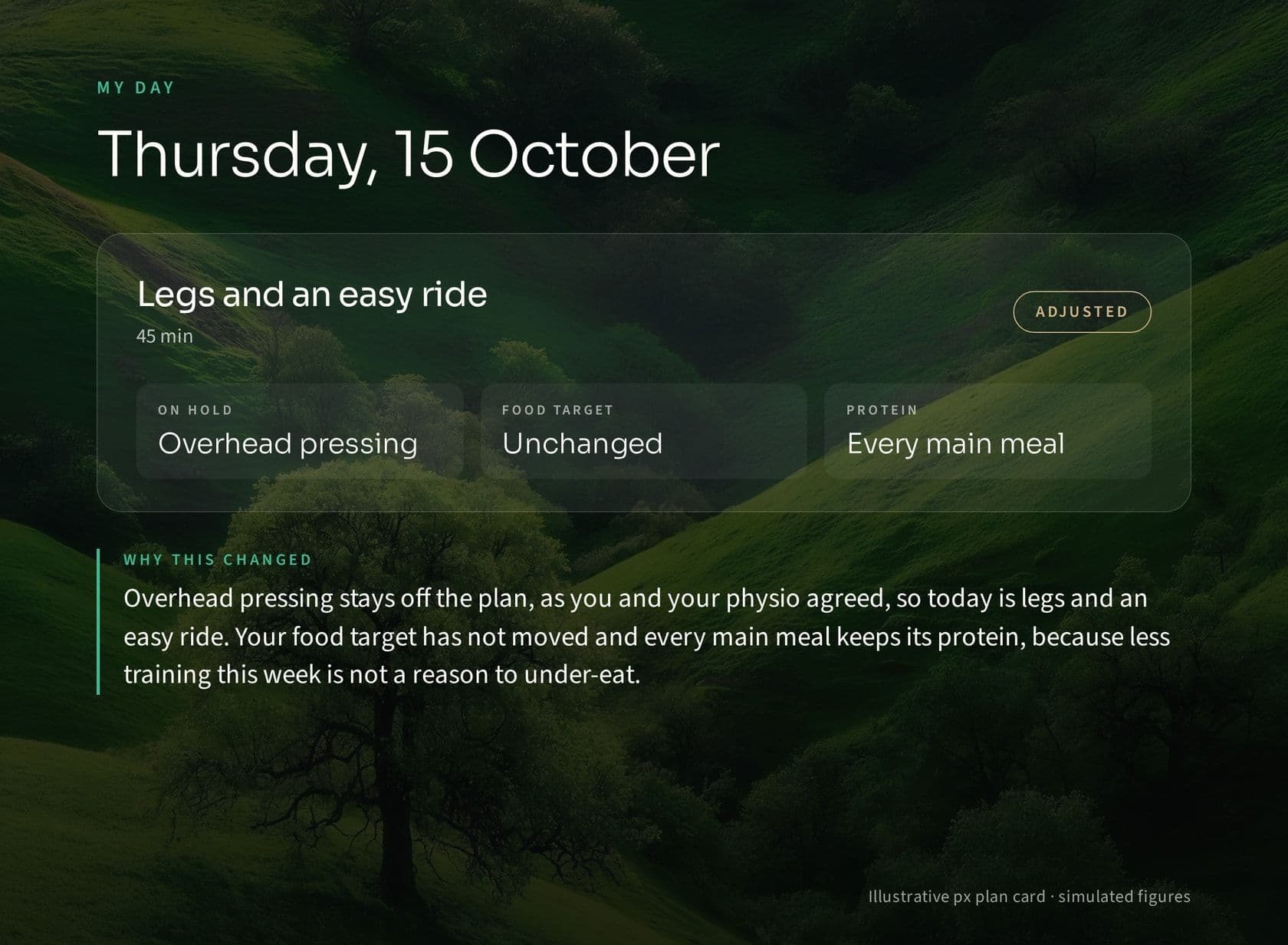
On an injured week, a plan card reads like this:
Overhead pressing stays off the plan, as you and your physio agreed, so today is legs and an easy ride. Your food target has not moved and every main meal keeps its protein, because less training this week is not a reason to under-eat.
That is Direction on an injured week: one plan that moves the training around the injury and holds the food where it was, with the reason on both.
Coming back from an injury? Keep the training honest and the food steady. px reads what you already track and builds one plan across training, mind and food before your day starts. Try px
Frequently asked questions
Should I eat less when I am injured and cannot train?
Less than instinct says. Tipton's 2015 review concluded that energy expenditure falls less after an injury than was once thought. In a study of 15 young adults, five days of eating well below needs lowered resting muscle protein synthesis by 27 per cent. Aim for roughly balance, and do not diet through an injury.
How much protein should I eat when injured?
Position stands put healthy people who exercise at 1.2 to 2.0 g per kilogram of bodyweight a day, and injury reviews propose similar or higher ranges. Those are evidence ranges, not a dose for you, and trials have not shown that extra protein alone prevents disuse muscle loss. Hold your usual protein across your meals and take any question about going higher to your clinician.
Do collagen or other supplements help an injury recover faster?
The evidence is early, small or mixed, and none of it is a reason to start one. A widely cited collagen study tested eight healthy men and measured a blood marker, not recovery in injured people. Creatine trials during immobilisation point both ways. px does not prescribe supplements. Whether any fits your situation is a decision for your doctor or physiotherapist.
What should change when I start training again?
The fuel follows the sessions back. As your clinician allows more load, the carbohydrate you ate around longer or harder work returns with those sessions. Protein should already be where it needs to be, because you held it. The pace of the return belongs to your clinician and your training plan, not your plate.
Can px tell me what to eat for my injury?
No, and it will not pretend to. px records an injury you tell it about and builds your training around it, but it does not assess injuries, clear you to return or change food for a specific injury. Your base food target and protein do not drop because you are injured. Your injury's specifics belong with your clinician.
Sources (15)
- Tipton KD. (2015). Nutritional support for exercise-induced injuries. Sports Medicine, 45(Suppl 1), S93-S104. https://doi.org/10.1007/s40279-015-0398-4
- Tipton KD. (2017). Nutritional support for injuries requiring reduced activity. Sports Science Exchange, 169. Gatorade Sports Science Institute. https://www.gssiweb.org/sports-science-exchange/article/sse-169-nutritional-support-for-injuries-requiring-reduced-activity
- Areta JL, Burke LM, Camera DM, West DWD, Crawshay S, Moore DR, Stellingwerff T, Phillips SM, Hawley JA, Coffey VG. (2014). Reduced resting skeletal muscle protein synthesis is rescued by resistance exercise and protein ingestion following short-term energy deficit. American Journal of Physiology: Endocrinology and Metabolism, 306(8), E989-E997. https://doi.org/10.1152/ajpendo.00590.2013
- Close GL, Sale C, Baar K, Bermon S. (2019). Nutrition for the prevention and treatment of injuries in track and field athletes. International Journal of Sport Nutrition and Exercise Metabolism, 29(2), 189-197. https://doi.org/10.1123/ijsnem.2018-0290
- Thomas DT, Erdman KA, Burke LM. (2016). American College of Sports Medicine Joint Position Statement. Nutrition and Athletic Performance. Medicine & Science in Sports & Exercise, 48(3), 543-568. https://doi.org/10.1249/MSS.0000000000000852
- Wall BT, Dirks ML, Snijders T, Senden JMG, Dolmans J, van Loon LJC. (2014). Substantial skeletal muscle loss occurs during only 5 days of disuse. Acta Physiologica, 210(3), 600-611. https://doi.org/10.1111/apha.12190
- Wall BT, Snijders T, Senden JMG, Ottenbros CLP, Gijsen AP, Verdijk LB, van Loon LJC. (2013). Disuse impairs the muscle protein synthetic response to protein ingestion in healthy men. Journal of Clinical Endocrinology & Metabolism, 98(12), 4872-4881. https://doi.org/10.1210/jc.2013-2098
- Kilroe SP, Fulford J, Jackman S, Holwerda A, Gijsen A, van Loon L, Wall BT. (2021). Dietary protein intake does not modulate daily myofibrillar protein synthesis rates or loss of muscle mass and function during short-term immobilization in young men: a randomized controlled trial. American Journal of Clinical Nutrition, 113(3), 548-561. https://doi.org/10.1093/ajcn/nqaa136
- Hughes AK, Francis T, Rooney J, Pollock RD, Witard OC. (2024). The effect of protein or amino acid provision on immobilization-induced muscle atrophy in healthy adults: a systematic review and meta-analysis. Experimental Physiology, 109(6), 873-888. https://doi.org/10.1113/EP090434
- Ye H, Yang J-M, Luo Y, Long Y, Zhang J-H, Zhong Y-B, Gao F, Wang M-Y. (2023). Do dietary supplements prevent loss of muscle mass and strength during muscle disuse? A systematic review and meta-analysis of randomized controlled trials. Frontiers in Nutrition, 10, 1093988. https://doi.org/10.3389/fnut.2023.1093988
- Morton RW, Murphy KT, McKellar SR, Schoenfeld BJ, Henselmans M, Helms E, Aragon AA, Devries MC, Banfield L, Krieger JW, Phillips SM. (2018). A systematic review, meta-analysis and meta-regression of the effect of protein supplementation on resistance training-induced gains in muscle mass and strength in healthy adults. British Journal of Sports Medicine, 52(6), 376-384. https://doi.org/10.1136/bjsports-2017-097608
- Jäger R, Kerksick CM, Campbell BI, et al. (2017). International Society of Sports Nutrition Position Stand: protein and exercise. Journal of the International Society of Sports Nutrition, 14, 20. https://doi.org/10.1186/s12970-017-0177-8
- Smith-Ryan AE, Hirsch KR, Saylor HE, Gould LM, Blue MNM. (2020). Nutritional considerations and strategies to facilitate injury recovery and rehabilitation. Journal of Athletic Training, 55(9), 918-930. https://doi.org/10.4085/1062-6050-550-19
- Shaw G, Lee-Barthel A, Ross MLR, Wang B, Baar K. (2017). Vitamin C-enriched gelatin supplementation before intermittent activity augments collagen synthesis. American Journal of Clinical Nutrition, 105(1), 136-143. https://doi.org/10.3945/ajcn.116.138594
- Backx EMP, Hangelbroek R, Snijders T, Verscheijden M-L, Verdijk LB, de Groot LCPGM, van Loon LJC. (2017). Creatine loading does not preserve muscle mass or strength during leg immobilization in healthy, young males: a randomized controlled trial. Sports Medicine, 47(8), 1661-1671. https://doi.org/10.1007/s40279-016-0670-2
Worth passing on? Share it.
