Why You Feel Guilty for Resting

Cameron Usher · Founder, px
2 September 2026 · 7 min read
Twelve years in competitive sport, trained alongside the Australian Olympic squad. px is the coach he needed after ten coaches, every wearable and every protocol.

Guilt about skipping a workout, in short
Guilt arrives reliably and produces training unreliably. Across 184 datasets, training because it matters to you correlated with actually doing it at about twice the strength of training out of guilt.
One missed session does not undo anything measurable. What replaces the argument is a prescribed recovery day with the reason attached, so rest is a decision rather than a lapse.
The guilt about skipping a workout usually arrives before you have even skipped it. It shows up at about 5:50am, while you are still deciding, and it does not present itself as guilt. It presents itself as motivation. That is the trick, and it is why this particular feeling has survived so long inside people who are otherwise perfectly rational about their own performance.
Here is what this post argues, up front. Guilt is not useless, but it is roughly half as useful as the thing it is impersonating, and there is a number for that. It reliably produces the sensation of being driven and unreliably produces training. And the specific story it tells you, that one missed session is the first domino, turns out not to survive contact with real life.
Guilt works. It just works about half as well.
Self-determination research splits motivation by where it comes from. Doing something because you find it satisfying in itself is intrinsic. Doing it because it genuinely matters to who you are is identified. Doing it to avoid feeling bad about yourself is called introjected regulation, which is the technical name for what you are feeling at 5:50am.
Across 184 independent datasets drawn from 166 sources, researchers measured how each of these correlated with actually exercising. Identified regulation came out at r = .36. Intrinsic motivation at r = .32. Introjected regulation at r = .18.
Guilt is not zero. That is worth saying, because the internet's version of this argument usually overshoots into "guilt never works," and it does work. It is simply half the engine that doing it because it matters to you is. If you have been running on the weaker one for years and finding it hard going, that is not a mystery, and it is not you.
There is a second finding that sharpens it. In a study measuring body-related guilt in men, guilt correlated .45 with guilt-based motivation, which is exactly what you would expect. Its correlation with actual physical activity was −.10, and not statistically significant.
So the feeling correlates strongly with feeling motivated, and not at all with training. Guilt generates the interior weather of discipline without generating the behaviour. It is a small cross-sectional study in one population, so hold it lightly, but it names something most people recognise: the most guilt-soaked periods of your training history were not your most consistent ones.
What actually happens after you miss one
Now the more useful question. You did skip it. What determines whether Tuesday happens?
Researchers asked people to recall a recent exercise setback and measured how they had responded to themselves about it. Self-compassion, meaning treating yourself the way you would treat a friend in the same position, correlated −.61 with rumination and .27 with re-engaging with the goal. Self-esteem, measured alongside it, predicted neither. Self-compassion added explanatory power over and above it.
That distinction is the one worth carrying. Feeling good about yourself in general did nothing. Being reasonable with yourself about this specific failure did.
It has been tested experimentally too, in an adjacent domain. Participants were given a food they had not planned to eat, then split: some received a brief prompt to be self-compassionate about it, some were left with their own reaction. The people who had been given the self-compassion prompt course-corrected. The ones left to self-criticism did not. It is a small study, in one population, in eating rather than training. But the mechanism it demonstrates is exactly the mechanism at stake here: what happens in the ten minutes after the lapse determines the next twenty-four hours, and self-criticism is not the option that protects them. The same loop runs through food rules, and it is one reason clean eating is not necessary for athletes.
The domino story is not true
You have almost certainly absorbed the idea that one missed session is the start of a slide. It has a name in the research literature, the abstinence violation effect, and in its popular form it goes: you break the streak, something in you gives up, and the whole thing unravels.
It is a real laboratory finding. It is also a finding that did not hold when researchers went and looked at real life. In two field studies, one tracking 127 people hourly across two days and another tracking 89 people over eight days with a deliberate mid-study violation, dieters did not overeat after breaking their diet in either study. The authors said the findings dispel the widely held belief that violations lead to a collapse in everyday life.
Whether it replicates for exercise specifically is not known. A systematic review of 37 prospective studies of lapse and relapse in physical activity found that most predictors had not been studied often enough to draw conclusions from at all. So the accurate position is: the domino story is a lab result that failed in the field, and nobody has properly tested it for training.
We are telling you that because it is true and because the alternative is letting a scary, unverified story do the work of motivating you. It is the same reason the px score dampens itself when the evidence behind it is thin. A number you have not earned is worse than no number, and a fear you cannot back is worse than no fear.
There is one thing we do know about missed days, and it is reassuring. In the classic habit-formation study, missing a single day reduced automaticity by about 0.29 against a typical daily gain of around 0.79, and the following day's resumption recovered roughly 0.55. Statistically, one skipped day was close to a normal day. The curve is not broken by imperfection. It is broken by abandonment, and those are very different things.
Rest is not the absence of training
The guilt survives partly on a false premise: that training is the input and rest is the gap between inputs. It is the wrong model, and the correction is not soft.
The 2018 expert consensus on recovery and performance in sport is explicit that fatigue and muscle damage are drivers of adaptation, not merely costs of it. The same document warns that chronically over-applying recovery interventions can blunt those effects. Rest is not a reward for work done. It is the phase in which the work becomes something.
The practical version, from the ACSM position stand, is that the same muscle group needs roughly 48 hours between resistance sessions. That is not a concession to weakness. It is the interval the adaptation requires.
Two things not to take from this. First, more rest is not automatically better, which is what the consensus warning is about. Second, this is a general training principle and not a diagnosis of your specific week. The sizing question, whether today is genuinely a recovery day or you are just flat, has its own answer in how to tell if you need a rest day, and it is a better answer than either voice in your head.
Motivation · what correlates with turning up
Guilt is roughly half as strongly associated with training as doing it because it matters
Identified regulation
Training because it matters to you
r = .36
Intrinsic motivation
Training because you enjoy it
r = .32
Introjected regulation
Training to stop feeling guilty
r = .18
Guilt works. It just works about half as well, and it costs more to run.
What replaces the argument
Notice what the argument actually is. Guilt says train, you rested on Sunday, what is wrong with you. Fatigue says rest, and said rest yesterday, and will say it again tomorrow. Neither voice is reading anything. Both have an agenda. Whichever wins, you spend the day half-convinced it was the wrong call, which is its own quiet tax.
The way out is not to find a tiebreaker with better values. It is to remove the vote.
If the decision was made before you woke up, by something that read your last fortnight of load, last night's sleep, your resting heart rate against your own baseline and what you have actually completed, then this morning is not a referendum. It is execution. That is the entire argument in how to stop skipping workouts, and it is why the timing of the decision matters more than the strength of your resolve at the moment you make it.
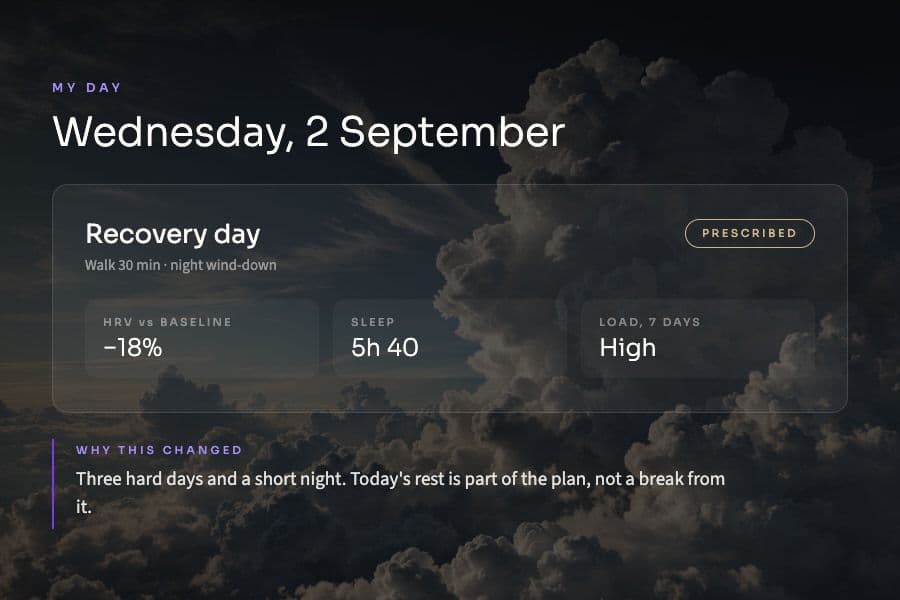
And when the answer is rest, it should arrive the way a session arrives: prescribed, specific, with a reason attached. Not "take today off," which your guilt will immediately relitigate, but something like three hard days and a short night have outrun your recovery, so today is forty easy minutes and Thursday takes the intervals. That sentence is checkable. You can disagree with it. What you cannot do is argue with it in the way you argue with a vague permission slip, because it is not asking for your feelings about it.
This also matters because the input you are least likely to notice is not training at all. A difficult week at work suppresses the same recovery signals a hard training block does, without appearing anywhere on your log, and the guilt has no idea. That gap is covered in how work stress affects your HRV, and it is the most common reason the guilty verdict is simply factually wrong.
None of this makes the feeling go away. It just stops it being the judge. Excellence is quiet and daily, and most of what it consists of is doing a reasonable amount of work on a day you did not feel like it, having already decided what reasonable meant while you were thinking clearly. That is what staying consistent with training actually looks like from the inside, and it is considerably less dramatic than the argument you have been having.
Stop having the argument. px reads what you already track and decides your day before it starts, across training, mind and food, with the reason attached. Try px.
Frequently asked questions
Is it normal to feel guilty about skipping a workout?
Yes, and it is common enough to have been studied under its own name in motivation research. What is worth knowing is that the guilt is doing less than it feels like it is doing. Across 184 datasets, guilt-driven motivation correlated with exercise at about half the strength of doing it because it genuinely matters to you.
Will one missed workout ruin my progress?
On the available evidence, no. In habit-formation data, a single missed day cost about 0.29 automaticity points against a typical daily gain of 0.79, and the next day recovered most of it. And the popular idea that one lapse triggers collapse comes from a laboratory effect that did not replicate in two field studies of real life.
How do I know if I need a rest day or if I am just being lazy?
Not from how you feel, which is the input both voices in your head are already using. The distinction between tired and under-recovered is checkable from signals you probably already collect, read against your own baseline rather than a population average. There is a full method in how to tell if you need a rest day.
Does rest actually help, or is it just recovery time?
Adaptation happens during recovery, not during the session. The 2018 international consensus on recovery in sport describes fatigue and muscle damage as drivers of adaptation, and notes that over-applying recovery interventions can blunt them. The general guidance is around 48 hours between sessions for the same muscle group.
What should I do instead of feeling guilty?
Two things with evidence behind them. Be reasonable with yourself about the specific miss, which predicted less rumination and more goal re-engagement where general self-esteem predicted neither. And move the decision earlier, so the call is made by something reading your actual signals rather than by an argument at 6am between two voices that are not reading anything.
Worth passing on? Share it.
