Decide Once, Trust It: The Morning Argument You Keep Having

Cameron Usher · Founder, px
· 8 min read
Twelve years in competitive sport, trained alongside the Australian Olympic squad. px is the coach he needed after ten coaches, every wearable and every protocol.

How to stop skipping workouts, in short
The problem is not the decision. It is when you make it. At 6am you have the worst information and the least resolve you will have all day.
Move the decision to the night before, plan for the collapse rather than the ideal day, and put the plan somewhere that presents it back to you already made. Then act on it once.
Here is how to stop skipping workouts, and it has almost nothing to do with wanting it more.
Every morning you reopen the same negotiation. The plan says intervals. You slept sort of fine. Your legs are ambiguous in a way that could mean anything. There is a meeting at nine that has grown since you last looked at it. And so, in about ninety seconds, in the worst physiological and psychological state you will be in all day, you overturn a decision that was already made.
Do that daily and you do not have a training plan. You have a daily referendum on one, and referendums are not won by the side with the better argument. They are won by whoever is holding the vote at the time.
The fix is not more resolve at 6am. It is to stop holding the vote at 6am.
The problem is when, not whether
You are not bad at deciding. You are deciding at the wrong moment, with the wrong inputs.
At 6am you have incomplete information about your own state, no memory of why the plan said what it said, a body that is still waking up, and a schedule that has already changed since you last saw it. You are also, crucially, deciding about something that will cost you effort in about eleven minutes. Every input in that moment is biased toward the smaller option, and none of them is data.
Compare that to the same decision made the night before, or made for you by something that has just read your last fortnight of load, last night's sleep, your resting heart rate against your own two-week baseline, and what you actually completed versus what was planned. Same question. Radically better conditions. Breakfast is settled the same way, which is why whether you need protein before a morning workout is usually answered at dinner the night before.
That is the whole move. The rest of this post is why it works and what the evidence actually supports, including the parts where the popular version of this advice is wrong.
Why the morning specifically is so bad at this
There is a popular explanation for this that you have almost certainly heard, and we are not going to use it, because it has not held up.
The idea that your willpower is a finite tank that drains through the day is called ego depletion, and it produced a famous statistic about parole judges and lunch. Over the last decade it has been tested properly. A twenty-three-lab replication involving 2,141 people found an effect of essentially zero. A second attempt across thirty-six labs and 3,531 people found the same, with the statistical evidence favouring no effect at all. A bias-corrected meta-analysis put the true effect below zero. In 2025, a pre-registered study of 231,076 real triage decisions concluded the results cast serious doubt on the idea as a general phenomenon. The parole-judges study has four published critiques, including a simulation showing that a perfectly rested, perfectly rational judge produces the same pattern from scheduling alone.
We mention all this because it would have been the easy paragraph to write, and because if you have read it elsewhere you deserve to know its status. The morning is a bad time to decide for reasons that need no theory: less information, more time pressure, an imminent cost, and a body that has not yet told you much.
What does hold up is narrower and more useful.
More options is not the problem. Uncertain options are.
The famous jam study, where fewer choices sold more jam, is the usual reference for this. It has been meta-analysed twice, and the honest picture is not the one in the business books.
Across 63 conditions and 5,036 participants, the average effect of having more options was 0.02, which is nothing. A second meta-analysis of 99 observations across 7,202 people found the same null result on average, and then found the conditions under which it becomes real. Choice overload emerged with high preference uncertainty (0.32), complex choice sets (0.55), and difficult decision tasks (0.37). Those four moderators explained 68% of the variance.
Read those conditions again, because they are a description of a specific person. Someone who has a lot of options, is uncertain what they actually want today, faces a genuinely complex decision, and has no rule for making it. Over-equipped and under-coached, in other words.
That is a more precise and more defensible claim than "too much choice is bad." It is not the number of options that costs you. It is making a hard choice while uncertain and without a rule.
Deciding in advance works, and by less than you have been told
This is where most articles quote a spectacular figure. One study of undergraduates found 91% of the group that specified when and where they would exercise were still training at follow-up, against 38% of controls. It is a real study, and it is two weeks long, in students, self-reported.
The meta-analytic picture is more sober. Restricted to randomised controlled trials of physical activity specifically, the pooled effect of if-then planning was 0.15, and not statistically significant. It became significant, at 0.25, only in the subgroup where the plan was reinforced during follow-up rather than made once.
Which tells you something quite specific. Writing the plan down once, in January, is close to inert. A plan that keeps being re-presented to you, adjusted and re-presented, is where the effect lives. The mechanism is not the act of deciding. It is having the decision in front of you again, already made, on the morning you would otherwise be renegotiating it.
The finding that inverts the usual advice
Here is the part that separates this from every "protect your 5am slot" post you have read.
Researchers ran a field experiment with 2,508 employees. Everyone chose a preferred two-hour window for the gym. One group was incentivised only for visits inside that window, building a rigid routine. Another was incentivised for visits whenever they happened. During the intervention the rigid group did more in-window visits, which is what you would expect, and also fewer visits outside it.
Afterwards, the flexible group's habit was the more durable one. Each additional out-of-window visit during the intervention predicted more future weekly visits than each additional in-window visit did, and the authors concluded that routine incentives create less persistent habits than flexible ones. Seventy-seven percent of surveyed psychology professors predicted the opposite before seeing the results.
So the instruction is not "train at the same time every day and defend it with your life." It is subtler and it matters: remove the decision, keep the flexibility. Those sound like the same thing and they are opposites. A rigid slot removes the flexibility and leaves the decision intact, so when the slot is destroyed by a real Tuesday, there is no plan and you are back at 6am arguing with yourself. What you want is the reverse: the question of whether is settled, and the question of when can move.
Timing · the inputs available at each moment
The same decision, made twelve hours apart, is not the same decision
At 6am
What you know about your own state
Incomplete, and still waking up
Why the plan says what it says
No memory of it
Your schedule
Already changed since you last saw it
Distance to the effort
About eleven minutes
The night before
Your last fortnight of load
Last night’s sleep
Resting heart rate against your own two-week baseline
What you actually completed, against what was planned
You are not bad at deciding. You are deciding at the wrong moment, with the wrong inputs.
Defaults are the one thing that survives
There is a broad literature on nudging, and it is in trouble. A large meta-analysis found a healthy overall effect, and then a re-analysis correcting for publication bias concluded that no evidence remained that nudges work as a general tool for behaviour change.
One exception survives that correction robustly, and it is the plainest one. Defaults. When retirement savings plans switched from opt-in to automatic enrolment, participation rose substantially, and a large share of people stayed at both the default contribution rate and the default fund, a combination almost nobody had chosen voluntarily before. The authors' summary was that large changes in behaviour can be produced simply by the power of suggestion.
A default is not persuasion. It is a decision that has already been made, that you are free to change and mostly will not. That is exactly what a training plan should be, and it is why the strongest version of this is not a reminder. A reminder is a prompt to decide. A default is a decision you have to actively overturn.

How to actually move the decision
Three steps. None of them requires you to become a different person.
One: settle whether, not when. Decide, in advance and away from the moment, how many sessions this week gets and roughly what they are. Two or three real sessions is a plan, not a compromise, and there is a full case for that in a training plan built for busy professionals. Do not attach them to sacred time slots you will lose.
Two: pre-decide the collapse. The evidence on planning is clear that the plan for the obstacle matters more than the plan for the ideal day. So: if Tuesday's session dies, it becomes twenty-five minutes Wednesday morning. Write the fallback, not just the plan. This is the single highest-return sentence you can add to your week.
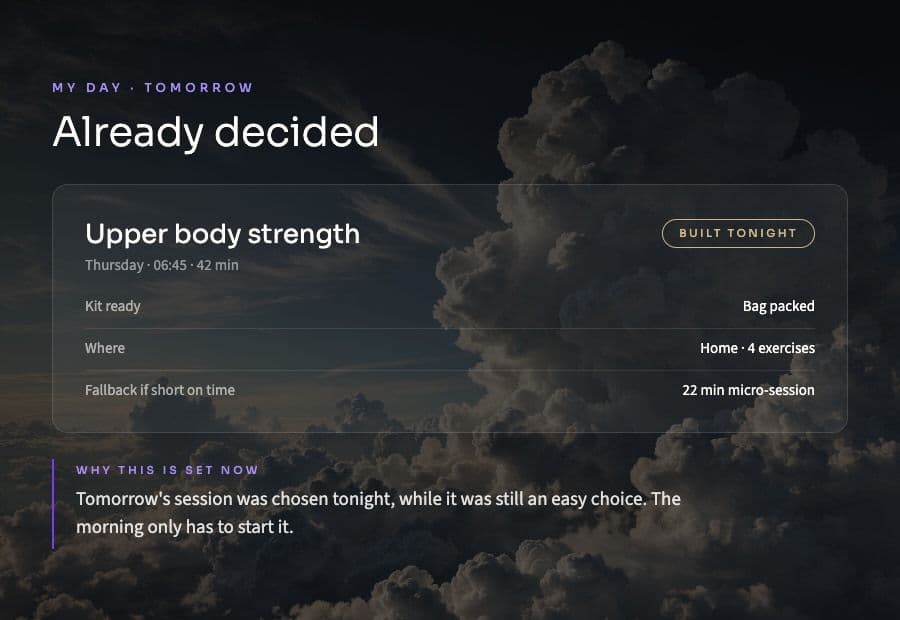
Three: put it somewhere that presents it back to you already decided. The reinforcement finding is the one that separates a plan that works from a plan you wrote. The decision needs to be in front of you on the morning, made, with the reason attached, so there is nothing to reopen.
That third step is the one px is actually for. Your day is built before you wake up, from your own signals rather than a template, and it arrives with a sentence explaining the call: three hard days and a short night have outrun your recovery, so today is easy and Thursday takes the intervals. You can overrule that. Most days you will not, because there is nothing to argue with, and because the version of you that would have argued is not awake yet.
And when you do miss one, the thing that determines Wednesday is not how hard you are on yourself about Tuesday. That is covered in guilt about skipping a workout, and the honest answer is the opposite of what most people do. The longer-run question, how any of this becomes automatic rather than effortful, is in how to build an exercise habit. Where this single decision sits inside the larger picture is how to stay consistent with training.
However you do it, the last discipline is the one that makes the others worth anything: make the call once, then act on it. Re-litigating at lunchtime, training angrily against your own red flag, or skipping a green-light day out of vague tiredness all burn the value of having asked. Deciding once and trusting it is not stubbornness. It is the only way the decision was ever going to be worth making.
Stop holding the referendum. px builds tomorrow before tomorrow starts, one plan across training, mind and food, with the reason on every call. Try px.
Frequently asked questions
Why do I keep skipping workouts even though I want to train?
Because wanting to train is not the missing piece. Across 29,600 people, roughly half of everyone who intended to be active was not, which means the failure is structural rather than a matter of desire. The most common structural cause is that the decision is being remade every morning, in conditions that reliably favour the smaller option.
Is it better to train at the same time every day?
Less clearly than you would think. In a field experiment with 2,508 people, rigid routine incentives produced less persistent gym-going than flexible ones, and out-of-window visits predicted more future activity than in-window ones did. The useful version is to make the session non-negotiable and the timing negotiable, rather than the other way round.
Does planning when I will exercise actually work?
Modestly, and mainly when the plan keeps being re-presented rather than made once. Across randomised trials of physical activity, if-then planning produced a pooled effect of 0.15 that was not statistically significant, rising to 0.25 when the plan was reinforced during follow-up.
What should I do when the week falls apart?
Have already decided. The strongest evidence in this area is that planning for the obstacle outperforms planning for the ideal day, by a wide margin. Shrink the session before you cut it: twenty-five real minutes keeps the pattern alive, and the comeback you avoid is worth more than the session you missed.
How is this different from just having more discipline?
Discipline is the resource you spend when the decision is still open. The point of settling it in advance is to need less of it, permanently, by moving the load from you to the plan. Every system that works by pushing you harder stops working when it stops pushing.
Worth passing on? Share it.
