The Pursuit: One Coach, One Plan for Today

Cameron Usher · Founder, px
· Updated · 17 min read
Twelve years in competitive sport, trained alongside the Australian Olympic squad. px is the coach he needed after ten coaches, every wearable and every protocol.

One coach for training, mind and food, in short
px is one coach that turns everything you already track into one plan for today, across training, mind and food, built around what you are pursuing. It works as one plan because those parts change each other: a short night raises how much you eat, and stress can slow recovery. A coach that sees all of them can make the call for the day.
"I am collecting more of my own health data than ever, trying to get better outcomes, and I am still lost in it, because none of it gives me direction."
px was built on that sentence. You may know a version of it. A watch that scores your night, an app that plans your sessions, another that counts your food, and a morning where all three disagree.
One coach is the answer to that morning. It reads what you already track across training, recovery, stress and food, and turns it into one plan for the day, with the reason attached to every change. It works for a plain reason: your sleep, stress, food and training change each other, and only a coach that sees all four can make the call.
This page sets out why, with the evidence, including the parts of the evidence that do not flatter the idea.
Why does more data not bring more clarity?
Start with the honest part. Tracking is not useless. An umbrella review in The Lancet Digital Health pooled 39 systematic reviews covering 163,992 people and found activity trackers add roughly 1,800 steps and about 40 minutes of walking a day (Ferguson et al., 2022). That is a real effect. Anyone who tells you wearables do nothing has not read the evidence.
The trouble is what happens next. In the same review, the gain was 1,127 extra steps a day at four to six months and 494 a day at up to four years. A 2024 meta-meta-analysis of 507 randomised trials and 206,873 people found digital programs added 1,329 steps a day by the end of the program. At follow-up the gain had shrunk to 752 and was no longer statistically significant (Singh et al., 2024). The data keeps flowing. The change does not.
People are also wearing trackers for longer than ever. Two surveys of tracker users run seven years apart found median use rose from 7 months in 2016 to 18 months in 2023. Over the same period, the share who said their tracker had improved their physical activity fell from 77 to 63 per cent (Beckett et al., 2025). More wear. Less change. These are self-reported answers from two online surveys, so read them as a direction of travel, not a verdict.
The myth: more feedback always helps
It feels obvious that more feedback means better performance. The evidence says otherwise. The best-known review of feedback research, 607 effect sizes and 23,663 observations, found feedback improved performance on average (d = 0.41), yet more than a third of feedback interventions made performance worse (Kluger and DeNisi, 1996). The pattern the authors found: feedback helps when it points your attention at the task, and loses its value as it points your attention at yourself. Those studies came from workplaces and laboratories, not training, so take the shape rather than the size.
Is a score the same as a plan?
No. A score describes. A plan decides. A sleep score of 58 at 6am is feedback about you: it says something happened overnight. It does not say whether 58 means skip the intervals, move them to Thursday, or train as planned because your last three weeks show you absorb nights like this well. That judgement needs your baseline, your recent training, the week ahead and, often, what you ate yesterday. In other words, it needs what the other apps know.
That is the gap: more measurement of the person, and no more instruction about the task. What is missing is not data. It is a decision.
More data · what a tracker adds over time
Tracking works, then fades
4 to 6 months
+1,127
Steps a day
Up to 4 years
+494
Steps a day
The data keeps flowing. The change does not.
Why do your fitness apps give you different answers?
Picture a Tuesday. Your training app has intervals booked. Your sleep score says 58 and suggests taking it easy. Your food log shows you finished yesterday 600 calories short. Your calendar has a 7am call you forgot about. Your mood tracker, if you still open it, knows you have been flat since the weekend.
Every one of those apps is right about its own lane. None of them is right about you. Each was built to report its own number, and none can see the others. So the job of reconciling them falls to the most tired and least objective version of you, at the worst possible hour.
That is the frustration of the over-equipped: training in one app, mood in another, food in a third, a number in each, no single answer, and a decision that still lands on you.
Is too much choice really a problem?
Only under certain conditions, and it is worth being precise, because choice overload is often overstated. A meta-analysis of 99 observations and 7,202 people found no overall effect of having more options until four conditions were taken into account: how complex the options are, how hard the decision is, how uncertain your preferences are, and whether your goal is simply to get the decision done (Chernev, Böckenholt and Goodman, 2015). When those conditions hold, more options make choosing harder.
Now read the four conditions against your 6am. Complex options, full of numbers you half understand. A hard decision: train, ease off or rest. Uncertain preferences: you want the session and you want the sleep. A goal of getting it over with before the day takes you. The over-equipped morning meets all four.
What do people do when the data leads nowhere?
Many of them stop. In a study of 159 people who had given up their trackers, those who quit because the data felt inaccurate or useless, or because they lost the motivation to track, tended to hold negative views of self-tracking in general. Giving up for good was most closely tied to that loss of motivation (Attig and Franke, 2020). The pattern is familiar. Data that never becomes a decision ends up in a drawer.
Why not just connect the apps?
Most of them already connect. Your food log can sit beside your sleep score on one screen, and your sessions can flow into a single dashboard. That solves storage, not decisions. Ten numbers on one screen are still ten numbers, and the job of weighing them still falls to you. The fix is not all your data in one place. It is one decision made from all of it, before you have to think about it.
Separate apps · one Tuesday at 6am
Three lanes, no crossings
Illustrative
- TrainingIntervals today
- Sleep58, take it easy
- Food600 kcal short yesterday
You, 6am
Every one of those apps is right about its own lane. None of them is right about you.
Why is fragmentation the failure, and not you?
If you have ever blamed yourself for a stalled month while three apps showed green ticks, read this part slowly.
The domains that fitness apps separate are not separate in your body. They change each other, daily, in ways that can be measured. Four examples, each from a different corner of the research.
Sleep changes food. In a meta-analysis of 11 controlled studies with 172 people, partial sleep loss raised the energy people ate by about 385 kcal, with no change in the energy they burned (Al Khatib et al., 2017). A food app sees the extra 385. It does not see the night that caused it.
Stress changes recovery. In 31 university students who trained with weights, those carrying more life stress recovered their strength more slowly in the hour after a heavy leg session, even after accounting for fitness and workload. The telling part: stress made no difference to how energetic, tired or sore they felt (Stults-Kolehmainen and Bartholomew, 2012). It is one small study with a short window, but the shape matters. A training app that asked how you felt would likely have been told "fine".
Food changes training. The International Olympic Committee's 2023 consensus on low energy availability, meaning too little food for the training you are doing, lists decreased training response, decreased recovery and decreased muscle strength among its performance outcomes (Mountjoy et al., 2023). It also notes that short, mild dips can be adaptable. The concern is a pattern, not one light day. A training app cannot see that pattern, because it cannot see your food.
Training changes food. The joint position statement of the Academy of Nutrition and Dietetics, Dietitians of Canada and the American College of Sports Medicine says energy needs vary from day to day with training volume and intensity. Its carbohydrate ranges run from 3 to 5 g per kg of body mass a day for light, skill-based training to 8 to 12 g per kg at very high loads (Thomas, Erdman and Burke, 2016). Those are evidence ranges, not a prescription for you. The point is that they move with the day. A food app with a fixed target does not.
Here is the same idea as one morning's view: what a single-domain app sees, and what sits just outside its lane.
| What happened | What a single-domain app sees | What it cannot see |
|---|---|---|
| A short night | A low sleep score | That you are likely to eat more today |
| A stressful stretch at work or home | Nothing, unless you log it | That your strength may recover more slowly after today's session, even if you feel fine |
| Too little food for the training you are doing | A number under target | That your response to training is what is at risk |
| A heavy training day | Minutes and heart rate | That your energy and carbohydrate needs moved with it |
Put those four crossings side by side and the failure is plain. Each app is honest about its own domain and blind to the cause sitting in the next one. You were not failing. The tools were. Pour more effort into a set of tools that cannot see each other and you get more logging, not more progress.
Fragmentation costs you one more thing, and it is easy to miss: a record. When the real decision happens in your head at 6am, nothing is written down about why the plan changed. Next week starts from memory, and memory flatters the good days.
Fragmentation · four crossings
The domains apps keep apart are not separate in your body
SleepchangesFood
About 385 kcal more eaten after short sleep
Al Khatib 2017
StresschangesTraining
Strength recovers more slowly, and you may not feel it
Stults-Kolehmainen 2012
FoodchangesTraining
Too little food: decreased training response
IOC 2023
TrainingchangesFood
Energy and carbohydrate needs move with load
Thomas 2016
Each app is honest about its own domain and blind to the cause sitting in the next one.
What does the evidence say one system has to get right?
"One system" can be sold badly. So before px, here is the honest version of what the research supports, and what it does not.
Does one coach mean changing everything at once?
It does not, and it should not. When researchers compared changing several behaviours at the same time with changing them one after another, they found no reliable winner. Across six randomised trials, three found a difference on at least one outcome, split both ways, and both approaches generally beat usual or minimal care (James et al., 2016). The authors concluded the two should be treated as equally effective, while noting how little evidence there is.
What matters more is how much you are asked to do. A meta-analysis of 150 research reports found a curved relationship between the number of recommendations people were given and the change they made. A moderate number produced the most change (Wilson et al., 2015). Past that point, adding more did not help.
So one coach should see everything and ask for little. One plan a day, sized to what you actually do, not to everything that could be improved.
Is bundling the same as integration?
No. Putting three features in one app is not the same as making one decision. A 2023 meta-analysis of 34 studies and 5,691 people looked at mobile programs that combined exercise, diet and mental health components. They reduced perceived stress a little, a standardised mean difference of 0.32 across six trials, but showed no significant effect on self-reported moderate-to-vigorous activity or diet quality (Zheng et al., 2023). Three tabs in one app are still three lanes.
What the evidence does reward is personalisation. A meta-analysis of 28 trials and 7,454 adults found apps and trackers added about 1,850 steps a day overall, and that programs with personalisation and text messaging were significantly more effective than those without (Laranjo et al., 2021). Reviews gathered in the umbrella review from the first chapter point the same way: programs that combined trackers with other components produced effects around 50 per cent larger than trackers used alone (Ferguson et al., 2022).
The standard, in five lines
Put together, a coach worth your attention should:
- Read across domains, because the cause of today's problem often sits in the domain next door.
- Decide once, before you train, so the morning is not a negotiation.
- Ask for little: one plan, sized to your recent reality, not your best week.
- Show its reason, so you can trust it or disagree with it on the merits.
- Say when it does not know, rather than dress thin data up as a verdict.
The pursuit is the standard. Those five lines are the standard for the coach. If you have not chosen yours yet, How to Set a Fitness Goal You Will Keep starts with the date.
How does px run Move, Mind and Fuel as one plan?
px is one coach across three pillars: Move for training, Mind for meditation and breathwork, and Fuel for food. They are not three products sharing a login. They run as a single loop: signals in, one plan out, the day adapts, and the record feeds tomorrow.
One system · how px runs
One loop, not three lanes
Signals in
Sleep · heart rate · HRV · training · mood · food · calendar
Read against your baseline
One decision, the reason attached
The day adapts
Written down
The record
What you did
What px changed, and why
What you did sizes what comes next
Feeds tomorrow
Not three products sharing a login. Signals in, one plan out, the day adapts, and the record feeds tomorrow.
Signals in
px reads what you already collect from 50+ apps and devices: Garmin, Oura, WHOOP, Polar and more connect directly, and Apple Watch, Fitbit and the rest reach it through Apple Health or Health Connect. A phone on its own is enough to start. It also plans around your calendar by category, such as travel, never by event title, and reads your own check-ins. Recovery signals are read against your own baseline, which the Move pillar sets out in full.
One plan out
Each morning, px writes one briefing with four cards: your Momentum, then Move, Mind and Fuel. Each card carries a short summary, three insights, what to focus on now, one action and the reason for it. An extra adjustment card appears only when something real has changed: HRV below your baseline, a genuinely short night, a low score held with enough confidence, an injury flag, or severe weather on a day you planned to train outside. If the day is on plan, there is no adjustment card. px does not invent a reason to change your day.
Each pillar can adjust today. Only px, looking at all three, changes the week. That is what one coach means: three pillars, one owner of the plan.
The day adapts, across pillars
This is where one system earns its place. These are rules px runs, not illustrations.
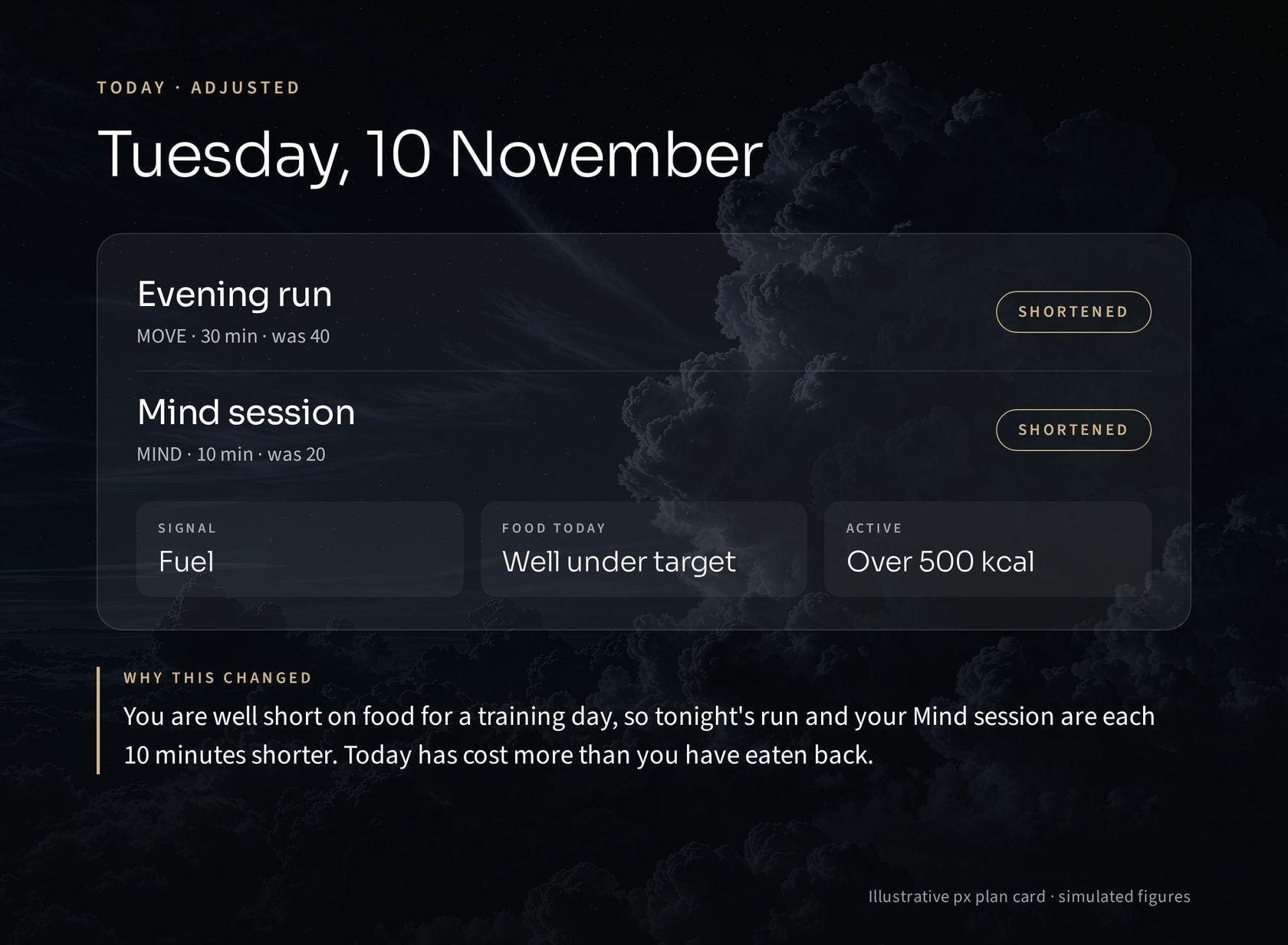
- Food changes training. If you are well under your food target late on a training day (under 70 per cent of it, with 500 or more active calories burned), that day's Move and Mind sessions are each trimmed by 10 minutes, and the session says why.
- Sleep changes training and food. After a short night, training eases. If your goal has you in a calorie deficit and your sleep was poor, the deficit is softened, and the Fuel card says why.
- Recovery changes the kitchen. On a day your recovery has collapsed, px caps the cooking time on the recipes it suggests. You will not be handed a fifty-minute recipe on a day like that.
- Mind changes Move. Low mood alongside a low HRV eases both your Move and your Mind sessions.
- Training changes food. Training you log raises the calorie target px coaches against, capped at a quarter above your base.
Here is how one of those decisions reads, in the coach's voice (illustrative):
You are well short on food for a training day, so tonight's run and your Mind session are each 10 minutes shorter. Today has cost more than you have eaten back.
One Fuel signal. Two other pillars moved. One reason. That is one coach in practice, and it is a sentence you can repeat to yourself without a chart: px cut tonight short, and here is why.
The record feeds tomorrow
Two things are kept from every day. The first is what you actually did. The sessions you complete set your capacity each week, and the training you log moves the food target the coach works from, so the plan follows your real week, not your intended one.
The second is what px changed. Changes to your Move and Mind sessions are written to a record called What px changed, which shows your last 14 days in your Plan. Each entry holds what moved (intensity, duration or volume), the signal behind it (such as sleep debt or overreach), how that signal was known (measured by a device or a log, reported by you, or inferred), and the exact sentence you saw that day, locked once the day ends. Changes to your food target show their reason on the Fuel card instead.
That record is not decoration. A meta-analysis of 138 studies and 19,951 people found that monitoring progress helped people reach their goals (d = 0.40), and helped more when the information was physically recorded, or reported to someone else (Harkin et al., 2016). A plan that writes down what it changed, and why, is one you can check, argue with and learn from.
When px does not know, it says so
Each pillar score needs at least three effective inputs. Below that, px shows no number and no band, only "learning", and falls back to your last earned score, labelled with the day it was earned. A coach that guesses with confidence is worse than one that admits the gap.
Sized to you, not to your best week
Each pillar has a capacity dial from 1 to 10 that you never see as a number. You see the prescription move instead. It follows what you actually complete: up a step after two weeks at 80 per cent or better, down a step after a week under 50 per cent. Sessions are pitched one step above it. The Mind pillar explains why sizing to your worst week is what keeps you going.
What px will not do
A system that sees more needs firmer limits, not looser ones. px does not diagnose, prescribe or hand you a supplement dose. Describing a pattern is coaching; naming a condition is medicine, and that belongs to a clinician. It never coaches a calorie deficit below your resting metabolic rate. Without your body data, the Fuel card asks you to set a target rather than inventing one. Food targets do not move for stress or mood; in a hard week, the coach's rule is regular meals and no restriction. And when a question needs a human, px says so.
Where do Move, Mind and Fuel go deeper?
This page is the why. The three pillar guides are the how. Each goes deep on one pillar and shows where it meets the other two.
- Move. Biometric training: how to turn your data into a daily plan covers the signals, why single numbers mislead, and how a reading becomes a session.
- Mind. How to stay consistent with training covers why intention alone fails, where dropout really happens, and what has been tested and held.
- Fuel. A training nutrition plan built around your actual training load covers why tracking food changes nothing on its own, and how food becomes the third input into the same plan.
Not more tracking. Not more effort poured into tools that cannot see each other. One coach, one plan, one reason on every change.
You already have the data. This is where it becomes a plan. px turns everything that shapes your day into one plan for today, across training, mind and food, built around what you are pursuing. Try px
Frequently asked questions
What does one coach for training, mind and food mean?
It means one coach reads your training, recovery, stress, mood and food together and turns them into one plan for the day, with the reason attached to each change. Sleep, stress, food and training affect each other, so a good decision about one needs the others. The point is the call for the day, not a dashboard.
How is a coach different from a fitness app?
A tracker records and reports. A coach decides. Most apps measure one part of your life well and give you a number, leaving you to weigh it against everything else. A coach makes the call across training, mind and food, around the day you actually have: what to train, how hard, what to eat, and why. It should also say when it cannot judge.
Can one app really coach training, nutrition and mindset?
Yes, if it treats them as one plan rather than three tabs. The evidence is candid on this: mobile programmes that simply bundle exercise, diet and mental health features have shown a small drop in stress and no clear change in exercise or diet quality (Zheng et al., 2023). What the evidence does reward is personalisation. That is the job of a single daily decision that uses all three signals, sized to what you actually complete.
Why do my fitness apps give me conflicting advice?
Because each one reports its own number and cannot see the others. A training app may book intervals while a sleep score says rest and a food log shows you ate too little yesterday. Each is right about its own domain. None is right about you, because the cause of today's problem often sits in the domain next door. Resolving that conflict is a coach's job, not yours at 6am.
Should I change my training, food and sleep all at once?
Not necessarily. Trials comparing changing several behaviours at once with changing them one after another have found no reliable winner (James et al., 2016). What matters more is the size of the ask: a meta-analysis of 150 research reports found a moderate number of recommendations produced the most change (Wilson et al., 2015). Let one system see everything, and ask you for a small number of things each day.
Sources (15)
- Al Khatib HK, Harding SV, Darzi J, Pot GK. (2017). The effects of partial sleep deprivation on energy balance: a systematic review and meta-analysis. European Journal of Clinical Nutrition, 71(5), 614 to 624. https://doi.org/10.1038/ejcn.2016.201
- Attig C, Franke T. (2020). Abandonment of personal quantification: a review and empirical study investigating reasons for wearable activity tracking attrition. Computers in Human Behavior, 102, 223 to 237. https://doi.org/10.1016/j.chb.2019.08.025
- Beckett D, Curtis R, Szeto K, Maher C. (2025). Changing user experience of wearable activity monitors over 7 years: repeat cross-sectional survey study. Journal of Medical Internet Research, 27, e56251. https://doi.org/10.2196/56251
- Chernev A, Böckenholt U, Goodman J. (2015). Choice overload: a conceptual review and meta-analysis. Journal of Consumer Psychology, 25(2), 333 to 358. https://doi.org/10.1016/j.jcps.2014.08.002
- Ferguson T, Olds T, Curtis R, et al. (2022). Effectiveness of wearable activity trackers to increase physical activity and improve health: a systematic review of systematic reviews and meta-analyses. The Lancet Digital Health, 4(8), e615 to e626. https://doi.org/10.1016/S2589-7500(22)00111-X
- Harkin B, Webb TL, Chang BPI, et al. (2016). Does monitoring goal progress promote goal attainment? A meta-analysis of the experimental evidence. Psychological Bulletin, 142(2), 198 to 229. https://doi.org/10.1037/bul0000025
- James E, Freund M, Booth A, et al. (2016). Comparative efficacy of simultaneous versus sequential multiple health behavior change interventions among adults: a systematic review of randomised trials. Preventive Medicine, 89, 211 to 223. https://doi.org/10.1016/j.ypmed.2016.06.012
- Kluger AN, DeNisi A. (1996). The effects of feedback interventions on performance: a historical review, a meta-analysis, and a preliminary feedback intervention theory. Psychological Bulletin, 119(2), 254 to 284. https://doi.org/10.1037/0033-2909.119.2.254
- Laranjo L, Ding D, Heleno B, et al. (2021). Do smartphone applications and activity trackers increase physical activity in adults? Systematic review, meta-analysis and metaregression. British Journal of Sports Medicine, 55(8), 422 to 432. https://doi.org/10.1136/bjsports-2020-102892
- Mountjoy M, Ackerman KE, Bailey DM, Burke LM, Constantini N, et al. (2023). 2023 International Olympic Committee's (IOC) consensus statement on Relative Energy Deficiency in Sport (REDs). British Journal of Sports Medicine, 57(17), 1073 to 1098. https://doi.org/10.1136/bjsports-2023-106994
- Singh B, Ahmed M, Staiano AE, et al. (2024). A systematic umbrella review and meta-meta-analysis of eHealth and mHealth interventions for improving lifestyle behaviours. npj Digital Medicine, 7, 179. https://doi.org/10.1038/s41746-024-01172-y
- Stults-Kolehmainen MA, Bartholomew JB. (2012). Psychological stress impairs short-term muscular recovery from resistance exercise. Medicine and Science in Sports and Exercise, 44(11), 2220 to 2227. https://doi.org/10.1249/MSS.0b013e31825f67a0
- Thomas DT, Erdman KA, Burke LM. (2016). American College of Sports Medicine Joint Position Statement. Nutrition and Athletic Performance. Medicine and Science in Sports and Exercise, 48(3), 543 to 568. https://doi.org/10.1249/MSS.0000000000000852
- Wilson K, Senay I, Durantini M, et al. (2015). When it comes to lifestyle recommendations, more is sometimes less: a meta-analysis of theoretical assumptions underlying the effectiveness of interventions promoting multiple behavior domain change. Psychological Bulletin, 141(2), 474 to 509. https://doi.org/10.1037/a0038295
- Zheng S, Edney SM, Goh CH, et al. (2023). Effectiveness of holistic mobile health interventions on diet, and physical, and mental health outcomes: a systematic review and meta-analysis. eClinicalMedicine, 66, 102309. https://doi.org/10.1016/j.eclinm.2023.102309
Worth passing on? Share it.
