Your Wearable Says Rest but You Feel Fine: What Do You Do?

Cameron Usher · Founder, px
· 7 min read
Twelve years in competitive sport, trained alongside the Australian Olympic squad. px is the coach he needed after ten coaches, every wearable and every protocol.

When your wearable says rest but you feel fine, in short
When your wearable says rest but you feel fine, you have two pieces of evidence that disagree, and neither wins by default. Open the reason behind the number, check what changed, and run a 10 minute warm-up test. If they still disagree, train with the effort trimmed. Rest fully if anything points to illness.
Why would your wearable say rest when you feel fine?
Because it measures different things from the ones you feel.
A readiness or recovery number is built from a few overnight inputs: heart rate variability (HRV, the variation in time between heartbeats), resting heart rate, sleep and your recent training. When one of those moves away from your normal, the number moves with it. A late meal, a couple of drinks, a hot night, a hard session two days ago or the start of a cold can all do it. Each maker builds its own, and what to do at each level is set out for Garmin Training Readiness, Oura Readiness and WHOOP Recovery.
What it cannot measure is the rest of your morning. It does not know that you feel sharp, that your legs feel light or that you have been looking forward to this session all week. You do.
These numbers are also new. A 2025 review looked at 14 readiness, recovery and strain numbers from 10 wearable makers and found little published, peer-reviewed evidence behind them (Doherty et al., 2025). That is not a reason to ignore yours. It is a reason to read it as one input, next to the others.
Should you trust the number or how you feel?
Both. How you feel is evidence too, and good evidence.
In a systematic review of 56 studies, Saw and colleagues compared what athletes reported, such as mood, fatigue, soreness and stress, with measures like heart rate and blood markers (Saw, Main and Gastin, 2016). The self-reported measures tracked changes in training load more sensitively and more consistently. The two kinds of measure often did not agree with each other.
Most mornings, though, they do agree. In 17 college sprint swimmers who measured HRV every morning, HRV ran higher on days they reported better sleep, less fatigue, less stress and a better mood (Flatt, Esco and Nakamura, 2018). So a morning where they split is unusual, and worth a closer look rather than a coin toss.
Each side also sees something the other cannot. Your wearable can pick up a change you have not noticed yet, such as the effect of last night's drinks. You can notice things it has no sensor for, such as heavy legs, a flat mood or a niggle. Neither one gets the final word on its own.
What should you check when they disagree?
Three things, before you decide anything.
- Which input moved. Open the detail behind the number. Is it HRV, resting heart rate, sleep or recent load? One input a little off is different from three inputs well off.
- What changed. A late dinner, alcohol, a long flight, a hot room, a hard session in the last 48 hours, a stressful day. If you can name the cause, the number usually makes sense.
- How your body actually feels. Not your motivation, your body. Soreness, heavy legs, a scratchy throat, a headache, a poor appetite.
Mood belongs on that list too. Does Your Mood Change What You Should Train? covers how a flat day and a low number read together, and what changes when just one of them is low.
If you have a fever, chest pain, or you feel unwell, stop here. Rest, and talk to a doctor. Feeling fine in the legs does not outrank feeling ill.
How do you test it with a warm-up?
Start the session and let the opening 10 to 15 minutes decide. A warm-up gives you live information that neither the number nor your mood had at 6am.
- Go easy for 10 minutes. Keep it at an effort you could hold a conversation at.
- Add 3 short pickups. Twenty to thirty seconds at the pace or weight of your main session, with easy time between.
- Compare with a normal day. Is your heart rate higher than usual for that effort? Does the effort feel harder than it should, out of 10? Do your legs respond?
- Decide. If it all feels normal, carry on with the session trimmed. If your heart rate runs high for the effort or your legs stay flat, switch to easy aerobic work and stop there.
The test costs you ten minutes and almost no fatigue. It also turns a debate in your head into a decision with a reason.
The number and how you feel
Two signals. Four answers.
The number says ready
Train as planned
Both signals agree.
The number says rest
Warm-up test, then train trimmed
Normal warm-up: the same session, hardest part cut, effort capped. Off: easy aerobic work.
The number says ready
Find out why, train easier
Or move the hard session.
The number says rest
Recover on purpose
Rest, or easy activity.
Fever, chest pain or unwell: rest, and talk to a doctor.
Feeling fine is evidence too. So is the number. Read them together.
So do you train or rest?
Read the two signals together and pick one of four answers.
| Your wearable says | You feel | What to do today |
|---|---|---|
| Ready | Good | Train as planned |
| Rest | Good, and the warm-up feels normal | Train, trimmed: the same session with the hardest part cut and the effort capped |
| Rest | Good, but the warm-up feels off | Switch to easy aerobic work |
| Ready | Flat, heavy or sore | Find out why, then train easier or move the hard session |
| Rest | Flat, heavy or sore | Recover on purpose: rest, or easy activity |
| Anything | Fever, chest pain or unwell | Rest, and talk to a doctor |
Trimmed is the answer people skip. It keeps the habit, keeps the session in your week and leaves something in reserve if the number was right. A day trimmed is a day trained.
If you choose rest, choose it as a decision, not a failure. Rest you picked for a reason is part of training. Why You Feel Guilty for Resting explains why the guilt shows up anyway, and why it rarely helps. Over a season, what counts is the run of weeks, and staying consistent with training is built on exactly these calls: the plan bends on the odd day so it does not break.
If your wearable is a Garmin and the warning is HRV status, Garmin HRV Status Unbalanced: What to Do goes through that one status in detail.
What if your wearable says rest several days in a row?
Then the pattern is the message, even if you feel fine.
One low morning can be noise. A week of them is a trend, and a trend is what these numbers read well. Ease the hard sessions for a few days, protect your sleep, and look for the cause: a heavier block of training, a stressful stretch at work, travel, or an illness coming on.
Feeling fine through a run of low mornings is common, and it does not cancel the run. If it lasts more than a week or two with no clear reason, or you start to feel run down, talk to a doctor. Do I Need a Rest Day? covers how to tell ordinary tiredness from something that needs more rest.
What does px do when the number and how you feel disagree?
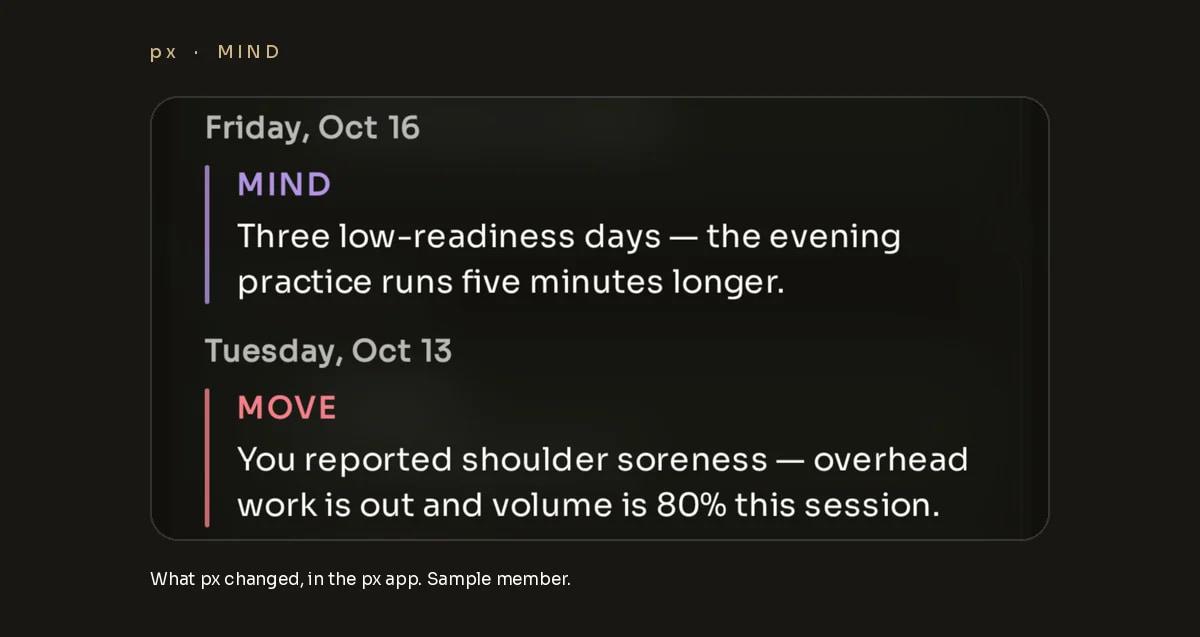
px reads both. It reads what your wearable records overnight, and it listens to what you tell it. Every change px makes to a session is recorded with where it came from: something your wearable measured, or something you reported. The sample record below shows both side by side: three low-readiness days that lengthened an evening practice, and a sore shoulder the member reported that took overhead work out of a session.
When low HRV and a low mood arrive together, px eases both your training and your Mind session. When the number is low but you slept well and say you feel good, the session can stay, with the reason written on it. That morning reads like this (illustrative):
"Your HRV is below your normal, but you slept well and say you feel good, so the session stays. The last interval is cut and the effort is capped at 7 out of 10."
That is the day's call in px: specific, made from both signals, with its reason. And you can still say no. If the warm-up tells you otherwise, tell px, and the day changes with you.
To run your own morning through the same signals, use the Should I train today? tool.
Feeling fine is evidence too. So is the number. Read them together.
Frequently asked questions
Should I work out if my readiness is low but I feel fine?
Usually yes, trimmed. Check which input pulled the number down and whether you can name a cause, such as a late meal or alcohol. Then run a 10 minute warm-up with a few short pickups. If heart rate and effort feel normal, train with the hardest part cut. If you feel unwell or feverish, rest and talk to a doctor.
Can I do strength training when my wearable says rest?
Often yes, at a lighter load. Keep the same lifts, drop a set or two, and stop each set a couple of reps further from failure than usual. Watch how the warm-up sets move. If the weights feel heavier than normal, switch to easy aerobic work or mobility instead, and move the heavy day back by two or three days.
Why is my readiness low after a good night's sleep?
Because sleep is one input among several. Readiness also draws on overnight HRV, resting heart rate and recent training, so a hard session two days ago, alcohol, a late meal, heat or the start of a cold can pull it down after a long night. Open the detail behind the number to see which input moved.
Sources (3)
- Saw AE, Main LC, Gastin PB. (2016). Monitoring the athlete training response: subjective self-reported measures trump commonly used objective measures: a systematic review. British Journal of Sports Medicine, 50(5), 281 to 291. https://doi.org/10.1136/bjsports-2015-094758
- Flatt AA, Esco MR, Nakamura FY. (2018). Association between subjective indicators of recovery status and heart rate variability among Division-1 sprint-swimmers. Sports, 6(3), 93. https://doi.org/10.3390/sports6030093
- Doherty C, Baldwin M, Lambe R, Burke D, Altini M. (2025). Readiness, recovery, and strain: an evaluation of composite health scores in consumer wearables. Translational Exercise Biomedicine. https://doi.org/10.1515/teb-2025-0001
Worth passing on? Share it.
